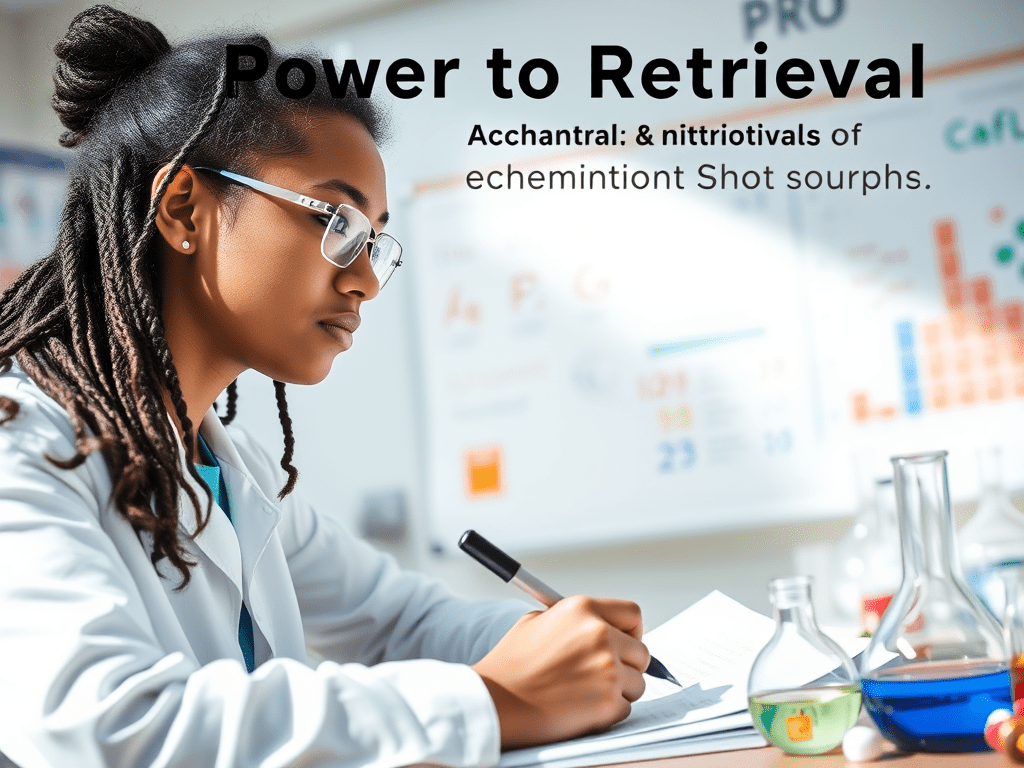
Welcome!
This week, we focus on retrieval practice, a simple yet powerful strategy that boosts long-term learning. Instead of just rereading notes, actively recalling information strengthens memory and deepens understanding—especially in STEM subjects like chemistry.
Why Retrieval Matters.
Every time a student recalls information:
- Neural connections are reinforced
- Memory becomes more accessible
- Understanding improves, making it easier to apply knowledge in new situations
Think of it as “exercise for the brain.” The more you retrieve, the stronger your learning becomes.
Evidence You Can Trust (and How to Apply It).
1. Roediger & Karpicke (2006):
- Finding: Students who actively recalled information outperformed peers who only re-read material by up to 50% on later tests.
- Application: Start lessons with brief retrieval quizzes (Rosenshine Principle 1: Review of Previous Learning). Encourage students to recall key chemistry concepts before introducing new material.
2. Butler (2010):
- Finding: Low-stakes quizzes improve not only memory but also the ability to transfer knowledge to new problems.
- Application: Ask targeted questions to check understanding (Rosenshine Principle 3) and provide guided practice before moving to independent retrieval (Principles 5–6).
3. Chemistry-Specific Example:
- Finding/Application: Instead of rereading balancing equations, students solve them from memory, then review mistakes. This strengthens understanding and highlights knowledge gaps. Scaffold initially (Principle 5: Guided Practice), then gradually increase independent retrieval (Principle 6).
4. Spaced Review Evidence:
- Finding: Combining retrieval with spaced repetition boosts long-term retention (Cepeda et al., 2006).
- Application: Revisit concepts at intervals (Principle 7: Weekly/Monthly Review), reinforcing memory while connecting new and prior learning.
- by combining research evidence with Rosenshine’s principles, retrieval practice becomes a structured, high-impact strategy rather than a random exercise.
Practical Tips for Teachers & Learners.
- Start Small: 3–5 question retrieval quizzes at the beginning of each lesson.
- Space It Out: Test recall after 1 day, 3 days, and 1 week.
- Explain to Learn: Students should explain answers aloud or in writing.
- Keep it Low-Stakes: Focus on learning, not grades. Mistakes are learning opportunities.
Interactive Challenge – 2-Minute Retrieval Quiz.
Try this at the start of your next lesson:
- Write down all the key chemistry terms you remember from last week.
- Solve one stoichiometry problem without looking at notes.
- List three properties of acids and bases from memory.
Compare with your notes afterwards. How much could you recall correctly? Where did gaps appear?
Bonus tip: Track your progress over a month to see how retrieval strengthens memory!
Closing Thought.
Retrieval practice, when guided by evidence and structured with Rosenshine’s principles, transforms memory into mastery. Start small, repeat often, scaffold when needed, and watch understanding grow. Next week, we’ll explore how to combine retrieval with spacing for maximum retention.
References
- Roediger, H. L., & Karpicke, J. D. (2006). Test-enhanced learning: Taking memory tests improves long-term retention. Psychological Science, 17(3), 249–255.
- Butler, A. C. (2010). Repeated testing produces superior transfer of learning relative to repeated study. Journal of Experimental Psychology: Learning, Memory, and Cognition, 36(5), 1118–1133.
- Rosenshine, B. (2012). Principles of Instruction: Research-based strategies that all teachers should know. American Educator, 36(1), 12–39.
- Cepeda, N. J., Pashler, H., Vul, E., Wixted, J. T., & Rohrer, D. (2006). Distributed practice in verbal recall tasks: A review and quantitative synthesis. Psychological Bulletin, 132(3), 354–380.
 MoyoEd Research
Leave a comment