Dr Caleb Moyo.
Classroom observation has long been a cornerstone of teacher development but is particularly powerful in science education. When done well, it helps teachers refine inquiry practices, strengthen student reasoning, and align instruction with how students learn science. When performed poorly, this becomes a compliance exercise that erodes trust.
This post draws on the latest research (2018–2025) to unpack what makes classroom observation effective in science classrooms and how schools can use it to drive genuine professional growth.
What is Classroom Observation in Science Education?
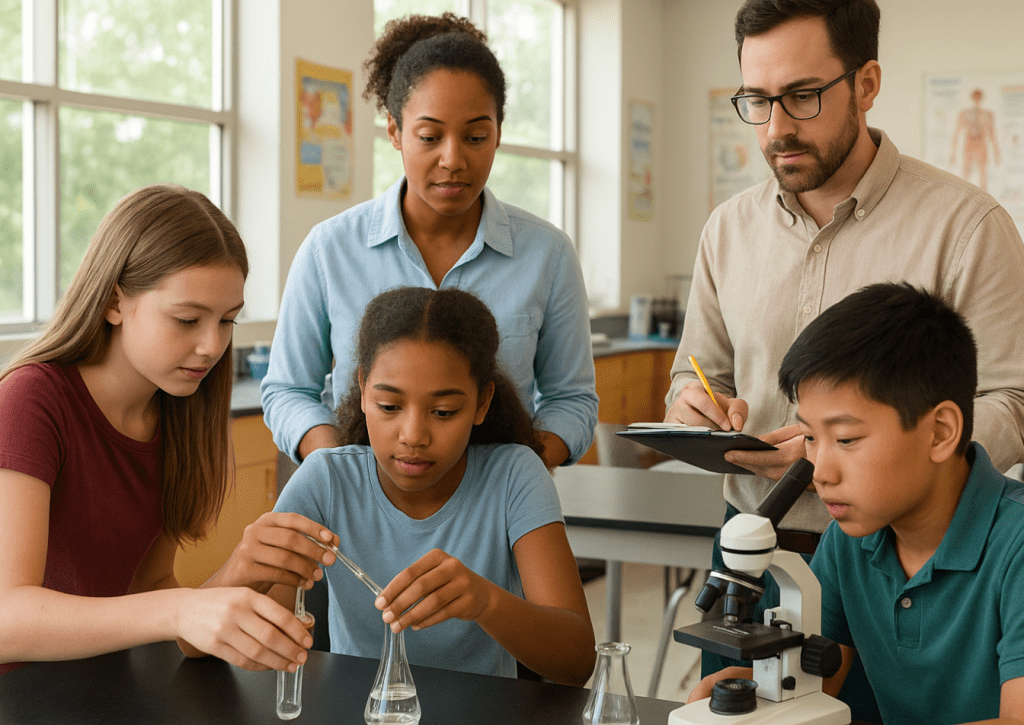
In simple terms, classroom observation is the process of watching a live or recorded science lesson to gather evidence about teaching and learning.
Its main goals include:
- Supporting teacher reflection and professional growth
- Enhancing instructional quality and student learning outcomes
- Informing targeted coaching and professional development
Over the past decade, observational practices have evolved from top-down evaluations to collaborative learning tools, often using video, peer feedback, and AI-supported analysis.
The Theory Behind Classroom Observation
Several learning theories explain why observations are essential to science education.
1. Constructivism
Students learn science best by actively building their understanding and not memorizing facts. Observations help to identify whether lessons allow for sense-making, evidence use, and model-based reasoning (National Academies, 2018).
2. Inquiry-Based Learning
Inquiry-oriented classrooms emphasize questioning, investigation, and argumentation. Observation allows teachers to see how effectively these practices unfold, especially how students handle evidence and reasoning (Antonio 2024).
3. Reflective Practice
Observation encourages reflection on action and converts everyday lessons into data for improvement. When used for formative purposes, it supports growth; when used for accountability, it often undermines growth.
What Makes a ‘good’ Lesson Observation?
Not all observations are created equal. Research suggests that effective science lesson observations share several key traits.
- A clear focus. Each observation targets 1–3 specific practices (e.g., questioning strategies, use of models).
- Objective, evidence-based criteria. Frameworks should be grounded in science pedagogy — not vague judgments.
- Reliable evidence. Observers collect time-stamped notes, short video clips, or student work samples.
- Actionable feedback. Teachers receive concrete next steps, not just their scores.
- Ongoing cycles. This growth occurs through multiple observations and coaching conversations.
Effective observers combine subject knowledge, empathy, and coaching skill. As recent work on rater reliability (White, 2024) reminds us, observational data are only as valid as the tools and training behind them.
The Right Conditions for Observation to Thrive
Observations thrive in a school culture that values trust, collaboration, and learning.
Here’s what research says about the conditions that make it work:
- Psychological Safety: Teachers must know observations are for growth, not judgment.
- Collaborative Culture: Peer observation and shared rubrics promote openness and shared language.
- Instructional Leadership: Leaders model coaching, protect reflection time, and align PD with observational evidence.
- Ongoing Learning: Both observers and teachers need training in feedback and science-specific pedagogy.
- Iterative Cycles: Effective systems use repeated “observe–reflect–practice–re-observe” loops.
International case studies show that schools with trust-based, learning-focused systems achieve deeper and more sustainable improvement than those emphasizing compliance.
What Works (and What Doesn’t): Lessons from 2018–2025 Research
✅ What Works.
1. Video-Based Coaching Cycles
Large-scale studies (Mathematica & IES, 2022) show that teachers who engage in structured, video-supported coaching improve both practice and student outcomes.
2. Specific, Practice-Focused Feedback
Feedback anchored to observable classroom moments — “Try prompting students for evidence after each claim” — drives improvement faster than general praise or critique.
3. Peer Observation Communities
Reciprocal peer coaching, when supported by training and trust, boosts teacher agency and uptake of feedback.
4. Hybrid Human–AI Models
Emerging tools can help identify patterns in talk time or questioning, freeing coaches to focus on interpretation and the next steps (Digital Promise, 2024).
❌ What Doesn’t Work
1. High-Stakes Observation for Evaluation
When tied to performance reviews or pay, teachers often “teach to the rubric,” narrowing instruction. Observation scores can also carry biases and errors (White, 2024).
2. One-Off Visits
Single observations capture snapshots and not trends. Growth requires cycles.
3. Poor Rater Training
Untrained observers provide inconsistent or inaccurate feedback and undermine trust.
4. Tech Without Interpretation
AI can support, but not replace, human judgment regarding students’ thinking and instructional nuances.
The New Research Landscape (2018–2025)
Recent research trends are reshaping our understanding of classroom observations.
- Evidence for Video Coaching: Proven to improve both teaching and learning (Clark and Max 2022).
- Deeper Focus on Validity and Bias: Researchers now use generalizability theory to separate “true signal” from observer error.
- AI-Augmented Tools: Early models show potential for scaling coaching capacity (Digital Promise, 2024).
- Peer-Led Frameworks: Structured peer observation supports trust and collective efficacy.
- Alignment with Learning Science: Observation rubrics now emphasize eliciting evidence, student reasoning, and formative assessment, aligning with what we know about how people learn (National Academies 2018).
A Practical Framework for Science Lesson Observation
Here, a simple 4-step process to make the next observation more meaningful:
1. Pre-Observation
- Clarify the purpose — growth, not evaluation.
- Choose one to three focal practices (e.g., questioning, modeling, and evidence use).
- Review lesson plans or student work beforehand.
2. During the Lesson
- Collect descriptive notes and, if possible, short video clips.
- Focus on student thinking and teacher prompts — not opinions.
3. Debrief Within 48 Hours
* Start with the teacher’s self-reflection. (crucial for non-specialists)
- Use evidence (quotes, clips) to anchor discussion.
- Offers 2–3 actionable strategies for the subsequent steps.
4. Follow-Up
- Co-plan a practice session or micro-teach.
- Revisit and re-observe to document growth.
Conclusion: Balancing Accountability and Growth
Effective classroom observation in science is not about catching mistakes; it is about helping teachers see and refine their practice.
When embedded in trust-based, reflective, and research-aligned systems, observation becomes one of the most powerful professional learning tools we have.
As AI, video, and peer coaching evolve, the challenge for schools is cultural, not technological: will we use observation for growth and learning, or for control and compliance?
For science educators, the answer matters because great science teaching thrives on curiosity, reflection, and feedback. Observation should too.
References
- National Academies of Sciences, Engineering, and Medicine 2018. How People Learn II: Learners, Contexts, and Cultures. Washington, DC: The National Academies Press. https://doi.org/10.17226/24783.Clark, M., & Max, J. (2022). Study of Teacher Coaching Based on Classroom Videos. Mathematica/IES.
- White, M., & Klette, K. (2024). Signal, error, or bias? exploring the uses of scores from observation systems. Educational Assessment, Evaluation and Accountability, 36(4), 505-528.Digital Promise. (2024). AI and Classroom Observation Explorations.
- Antonio, R. P., & Prudente, M. S. (2024). Effects of Inquiry-Based Approaches on Students’ Higher-Order Thinking Skills in Science: A Meta-Analysis. International Journal of Education in Mathematics, Science and Technology, 12(1), 251-281.

 MoyoEd Research
Leave a comment