Dr Caleb Moyo.
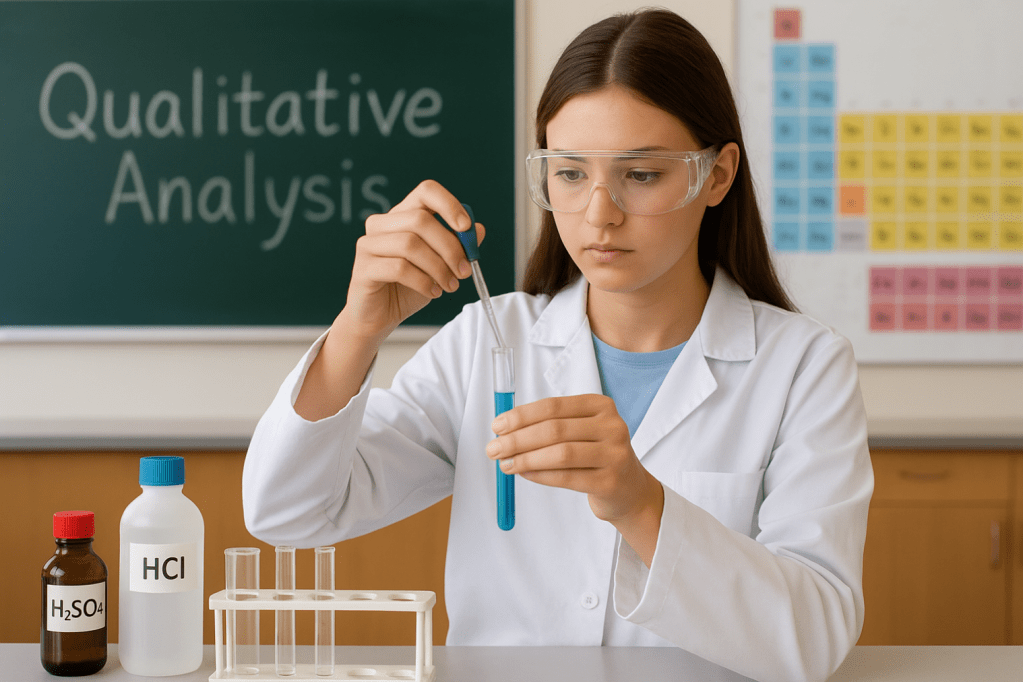
Qualitative analysis, the identification of ions and gases through characteristic reactions, remains a cornerstone of practical inorganic chemistry in both the Cambridge International (CIE) and Edexcel IAS/IAL Chemistry syllabuses. It provides a setting in which students demonstrate manipulative competence, apply theoretical understanding, and cultivate scientific values. To teach this effectively, educators must anchor their instruction in empirical evidence from chemistry education research while maintaining fidelity to traditional laboratory practice.
1. Foundational Prior Knowledge.
Before students begin qualitative analysis, they must have a secure conceptual foundation. Learners should be fluent in chemical formulae, ionic compounds, and solubility rules, as a weak grasp of ionic behaviour often leads to misconceptions during testing procedures (Treagust, 2002). Students must understand acid–base reactions, precipitation processes, and gas evolution, which underpin the analytical logic of ionic tests (Kind & Overton 2018). Students must be comfortable with handling, litmus paper(s), a glowing splint and test tube holder simultaneously.
Additionally, empirical studies have highlighted that insufficient familiarity with laboratory apparatus and procedures limits practical performance (Galloway & Bretz, 2015). Therefore, instruction should begin with explicit demonstrations of correct reagent handling, test tube techniques, and heating methods for tests on gases. Students who cannot confidently manipulate equipment risk conflating procedural errors with chemical observations.
Finally, the introduction of the concepts of partial knowledge and uncertainty is crucial. Learners should appreciate that chemical identification is interpretative; results are seldom absolute but must be reasoned and cross-checked. This disposition toward evidence-based judgment is central to scientific thinking (Abrahams and Millar, 2008).
2. Required Skills.
Research consistently shows that effective laboratory learning develops when students engage in active, reflective manipulation rather than passive (recipe) confirmation (Hofstein & Lunetta, 2004). The essential skill domains for qualitative analysis include:
- Accurate observation and recording: Students must systematically describe precipitate colours, gas evolution, and flame colours using precise terminology. Reliability increases when observations are structured using checklists or data tables (Rollnick et al., 2001).
- Procedural control: Understanding the order of addition, reagent concentration, and “excess reagent” testing distinguishes analytical reasoning from trial-and-error.
- Deductive reasoning: The ability to infer ion identity from observation (e.g., cream precipitate + solubility in concentrated ammonia ⇒ bromide) integrates logic and chemical knowledge.
- Evaluation and error recognition: Laboratory work fosters analysis and evaluation, two higher-order domains in practical competence frameworks (OCR, 2019). Students should critique anomalies and hypothesise their causes rather than ignore them.
- Communication of findings: Accurate written reasoning, use of ionic equations, and appropriate notation consolidate understanding and align with exam board assessment objectives. Here, students generally lack the link between the microscopic (ionic level), macroscopic (observations), and symbolic (equations) representations to show understanding, (Mammino, 2005).
3. Core Knowledge of Qualitative Analysis.
A-level learners must master both content knowledge (specific tests) and conceptual understanding (i.e., underlying chemistry). Within the syllabuses, the emphasis is on:
- Anion tests:
- Carbonate—effervescence with acids releasing CO₂ (turns limewater milky).
- Sulfate—acidify, then add Ba²⁺ to form a white BaSO₄ precipitate.
- Halide—acidify, then add Ag⁺; observe white/cream/yellow precipitate and solubility trends in ammonia.
- Cation tests:
- Ammonium—add NaOH and warm gently; released NH₃ turns damp red litmus blue.
- Transition metals—precipitation with OH⁻ or NH₃, and flame colours (Cu²⁺ → blue-green; Na⁺ → yellow; K⁺ → lilac, Ba2+ → apple green).
Beyond memorisation, students should comprehend why these reactions occur. For instance, explaining BaSO₄ formation in terms of a low solubility product (Ksp) connects analytical practice with equilibrium theory (Atkins et al., 2022). Similarly, complex ion formation explains why AgCl dissolves in ammonia, whereas AgI does not, demonstrating the predictive power of chemical principles. Effective teachers model this reasoning verbally during demonstrations, thereby transforming rote testing into a conceptual inquiry (Kind & Overton, 2018).
4. Values and Attitudes.
Laboratory pedagogy must cultivate enduring scientific values.
- Safety and responsibility: Mastery of a procedure without safety is a hollow achievement. Students must understand chemical hazards and proper waste disposal in accordance with CLEAPSS and school regulations.
- Precision and perseverance: Qualitative analysis rewards patience and disciplined repetition; hasty testing leads to false inferences.
- Curiosity and analytical mindset: Framing each unknown as a chemical puzzle fosters engagement and intellectual investment.
- Reflection and metacognition: Abrahams and Millar (2008) found that explicit reflection after practical work substantially deepens conceptual learning in students. Encourage short reflective write-ups on reliability, anomalies, and potential improvements to the model.
- Integrity and honesty: Students must record results as observed, acknowledging any uncertainty. Academic integrity begins in a test tube.
5. Teaching Workflow and Strategy
A structured, research-informed sequence can enhance mastery and transfer of learning
- Pre-lab preparation: Review prerequisite theory through quick diagnostic questions and a concept map linking ions to reagents (Treagust, 2002).
- Teacher demonstration with think-aloud reasoning: Model the process and explicitly verbalise the “why” behind each step, reinforcing metacognitive awareness (Galloway & Bretz, 2015).
- Guided practical: Students perform standard tests using known samples. Provide scaffolds, such as reagent cards or flowcharts.
- Problem-solving with unknowns: Assign mixtures or unknown ions, for example, CuCl2 and FeCl3. Students are required to plan a logical test sequence. This promotes the transfer from procedural to strategic knowledge (Hofstein & Lunetta, 2004).
- Collaborative debrief: Facilitate peer comparisons of results. Discussion and argumentation strengthen conceptual retention (Rollnick et al., 2001).
- Reflection and evaluation: Students submit brief practical commentaries focusing on accuracy and error sources. They may also critique a given procedure and/or observation.
- Extension to theory: Integrating ionic equations, solubility equilibria, and complex formation to connect observations with explanations. Encourage students to revisit their test tubes for extra observations, such as aerial oxidation at the interphase and darkening of colour in direct sunlight etc. In addition, practicals should be conducted when the relevant content is covered to ensure the proper context for students.
- Retrieval and reinforcement: Revisit qualitative analysis later in the course using mini-practicals or exam-type questions. Spaced repetition improves long-term retention (Atkins et al. 2022).
This workflow embodies the DR ICE philosophy—Deepening Thinking, Role Modelling, Impact of Learning, Challenging, and Expectations—by blending modelling, challenge, and reflection into each cycle of practical work.
6. Alignment with IAS/IAL and Cambridge Requirements.
Ensure full compliance with the specific syllabus learning outcomes.
- Cover the listed ions and gases comprehensively (Cambridge International Examinations 2024).
- Reinforce practical endorsement criteria: planning, implementing, analysing, and evaluating (OCR, 2019).
- Integrate past-paper style questions (e.g., “Explain why the precipitate dissolved in excess ammonia”) to develop examination confidence.
- For Edexcel IAL, extend to flame tests and transition metal chemistry to meet advanced practical depth.
Conclusion.
Teaching qualitative analysis effectively requires more than just demonstrating test-tube reactions. This demands the deliberate cultivation of prior knowledge, practical reasoning, and scientific values. Empirical evidence affirms that when students participate actively i.e. observing, inferring, reflecting, and discussing, they internalise both conceptual understanding and laboratory discipline (Hofstein & Lunetta, 2004; Abrahams & Millar, 2008). By combining traditional rigour with research-informed pedagogy, teachers can transform qualitative analysis from a checklist exercise into a powerful apprenticeship in scientific thinking.
References
Abrahams, I., & Millar, R. (2008). Does practical work really work? A study of the effectiveness of practical work as a teaching and learning method in school science. International Journal of Science Education, 30(14), 1945–1969.
Atkins, P., de Paula, J., & Keeler, J. (2022). Atkins’ Physical Chemistry (12th ed.). Oxford University Press.
Cambridge International Examinations. (2024). A-Level Chemistry (9701) Syllabus and Teacher’s Guide. Cambridge University Press.
Galloway, K. R., & Bretz, S. L. (2015). Development of an assessment to measure students’ meaningful learning in the undergraduate chemistry laboratory. Journal of Chemical Education, 92(7), 1149–1158.
Hofstein, A., & Lunetta, V. N. (2004). The laboratory in science education: Foundations for the twenty-first century. Science Education, 88(1), 28–54.
Kind, V., & Overton, T. (2018). Chemistry Education: Best Practice, Opportunities and Trends. Royal Society of Chemistry.
OCR. (2019). Chemistry Practical Skills Handbook. Oxford Cambridge and RSA Examinations.
Rollnick, M., Zwane, S., Staskun, M., Lotz, S., & Green, G. (2001). Improving science teaching skills through teacher development: A model for in-service education. International Journal of Science Education, 23(3), 347–362.
Treagust, D. F. (2002). Diagnosing Students’ Misconceptions in Science. Springer.
Mammino, L., & Cardellini, L. (2005). STUDYING STUDENTS’ UNDERSTANDING OF THE INTERPLAY BETWEEN THE MICROSCOPIC AND THE MACROSCOPIC DESCRIPTIONS IN CHEMISTRY. Journal of Baltic Science Education, (7).
 MoyoEd Research
Leave a comment