Dr. Caleb Moyo
Teaching A-level Chemistry has never been a walk in the park; it demands conceptual precision, practical fluency, and reasoning skills that are sharp enough to split a benzene ring. This article discusses research from 2000 to 2025 to clarify the shaky status of learning styles and provide concrete, evidence-based active learning methods that reliably improve achievement in secondary science classrooms.
Understanding the Theory: How Students Actually Learn.
Cognitive science has consistently shown that learning is strengthened through active engagement, retrieval practice, multiple representations, and structured guidance. These principles hold across subjects, but are especially vital in chemistry, where abstract ideas (orbitals, equilibrium, energetics) demand conceptual scaffolding and hands-on reasoning.
Multimodal teaching, using diagrams, models, verbal explanations and symbolic representations, is powerful because it aligns with how memory encodes information, not because students have fixed “types.”
Learning Styles: A Critical Evidence-Based Examination.
What the Theory Claims.
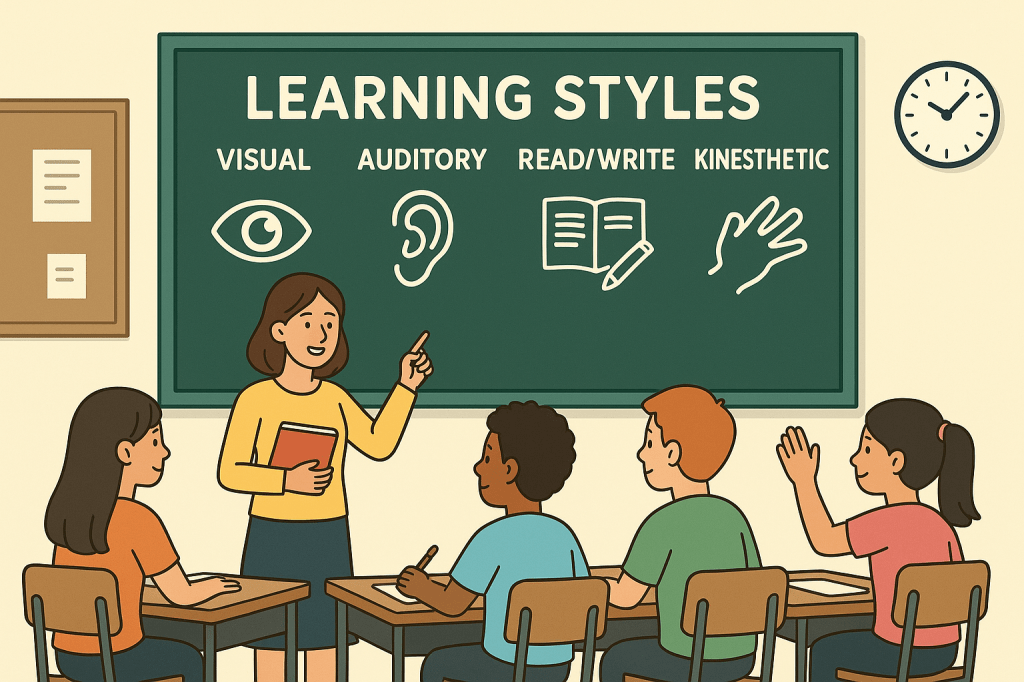
Learning-style models (VARK, Kolb, visual/auditory/kinesthetic) argue that students learn best when the instruction matches their preferred style.
What the Evidence Says.
Major reviews and meta-analyses (e.g., Pashler et al., 2008; Coffield et al., 2004; recent syntheses up to 2025) show no robust evidence that teaching a student’s identified style improves performance. Studies that have explicitly tested the matching hypothesis, the idea that “visual learners learn best visually,” etc., repeatedly find no meaningful benefit.
Why the Myth Persists.
- Multimodal teaching works; therefore, people misattribute the benefits to learning styles.
- Students like being categorised (“I’m a visual learner”), and teachers value anything that appears personalised.
- Learning styles are simple to explain, even if evidence indicates otherwise.
Practical implications for teachers.
Acknowledge student preferences but do not design lessons around style labels. Instead, it is designed around the cognitive load, conceptual progression, and active engagement.
Active Learning: Evidence-Based Alternatives.
A massive body of STEM research (Freeman et al., 2014; Theobald et al., 2020; chemistry-specific studies from 2000 to 2025) shows that active learning significantly improves test scores, conceptual understanding, and retention, even in high-stakes courses.
Below are the most effective strategies for classroom-ready workflows in A-level Chemistry and science.
Evidence-Based Active Learning Methods for A-Level Chemistry.
1. POGIL (Process-Oriented Guided Inquiry Learning)
What It Is.
Students work in small groups through structured activities that move them from data → model → application. The teacher acts as a facilitator, not a lecturer.
Why It Works.
Guided inquiry supports deep processing, collaboration, and concept formation, all of which benefit chemistry learning (meta-analyses in chemistry education have consistently shown positive effects).
How to Implement (A-Level Workflow).
- Pre-lesson (5–10 min): Short reading or teacher-created overview video.
- Group roles: Manager, recorder, technician, and spokesperson. Rotate weekly.
- POGIL activity cycle:
- Explore: Students examine data or representations.
- Invent/Propose: Students articulate the underlying concepts or rules.
- Apply: Students solve extension questions that test flexible transfers.
- Whole-class synthesis: The teacher clarifies critical points.
- Post-lesson retrieval quiz: Cement the takeaways.
A-Level Example.
- Predicting titration curves from empirical volume–pH data, (IAL).
- Deducing electron configuration rules from ionization energy graphs, (IAS).
2. Flipped Learning.
What It Is.
Core content (e.g., redox definitions, Boltzmann Distribution curves, Shapes of molecules and ions) is delivered before class via short videos or notes, and class time is used for problem solving and application.
What Research Shows.
Flipped classrooms outperform traditional lectures when in-class time is structured around active tasks and does not extend teacher talk.
Workflow implementation.
- Pre-class: 8–12-minute video + 5-question online quiz for accountability.
- In class:
- Mini-diagnostic (2–3 questions).
- Group problem-solving worksheet (graded for completion).
- The teacher circulates and intervenes in the misconceptions.
- After class:
- Cumulative Spatial Retrieval Questions.
A-Level Example.
Students watch a short introduction on acid-base equilibria and then solve problems requiring pH calculation of polyprotic acids during lesson time.
3. Inquiry-Based and Problem-Based Learning (IBL/PBL).
What It Is.
Students learn content by working through realistic problems, industrial contexts, environmental chemistry, pharmaceutical synthesis, and so on.
Why It Works.
When scaffolding is strong, IBL/PBL improves problem-solving, reasoning, and motivation (chemistry education research consistently supports this with medium effect sizes).
Workflow implementation.
- Present a complex problem (e.g., Design a buffer for a biochemical process at pH 7.4).
- Provide checkpoints and mini-lessons at key bottlenecks.
- Require a final, defendable solution—poster, whiteboard explanation, or short report.
- Include structured peer feedback.
A-Level Example
Students analyse water quality data to determine likely pollutant sources using stoichiometry, equilibria, and redox reasoning.
4. Peer Instruction.
What It Is.
Students first answer a conceptual question individually, then discuss with peers, and answer again.
Evidence.
Large meta-analyses have shown that peer instruction significantly enhances conceptual understanding, especially in topics with deep misconceptions.
Workflow implementation.
- Present a conceptual question (e.g., why does adding a catalyst not change the equilibrium position?).
- The students vote individually.
- Students discuss this with their partners.
- Students vote again.
- Teacher explains the reasoning, addressing misconceptions directly.
A-Level Example.
Electron configuration anomalies, enthalpy interpretation, and entropy reasoning.
5. Retrieval Practice.
What It Is.
Frequent low-stakes recall tests improve long-term retention dramatically more than restudying.
Research Base.
Hundreds of controlled studies (Roediger & Karpicke; Agarwal et al.) confirm strong, consistent effects across subjects, especially in high-content fields like Chemistry.
Implementation Workflow
- Start every lesson with a 5–7-minute no-note quiz.
- Weekly cumulative quizzes combining old and new topics.
- Spaced retrieval: revisit topics weeks later (kinetics → equilibria → energetics → back to kinetics).
A-Level Example.
Spiral quizzes: atomic structure → bonding → energetics → back to atomic structure.
Common misconceptions and hurdles
1. Overreliance on Learning Styles.
Matching tasks to “visual/kinesthetic/auditory learners” wastes planning time and yields no measurable benefit. Instead, use multiple representations and active practice.
2. “Active Learning = Group Work”
Not all group work is active learning. Without clear roles, structured tasks, or teacher facilitation, group drift and misconceptions flourish.
3. Cognitive Overload.
Throwing students into unguided inquiry too early overwhelms novices. Start with guided inquiry or worked examples and then gradually release responsibility.
4. Assessment Misalignment.
If your exam questions demand multi-step process reasoning, but the lessons focus on surface features, students will underperform. Align questioning with higher-order demands. Bloom’s taxonomy comes in handy here.
5. Skipping Retrieval.
Teachers love problem-solving but often neglect cumulative recall. Retrieval is the backbone of durable learning and is not omitted.
Practical QuickStart Checklist for A-Level Chemistry.
- Add a 5-minute retrieval starter quiz to every lesson.
- Use two POGIL-style lessons per topic, especially for Equilibria, Qualitative Analysis, Kinetics, and Organic mechanisms.
- Introduce peer instruction questions at least twice per lesson.
- Record short video micro-lessons (8–12 min max) for flipped segments.
- Use contextualised PBL problems once per half term.
- Build a concept question bank targeting common A-level misconceptions.
Conclusion: Teaching That Works, Teaching That Lasts.
The allure of learning styles is understandable; they offer a tidy way to categorise learners. However, A-level Chemistry does not reward wishful thinking; it does reward precision. The strongest evidence from 2000 to 2025 points decisively toward structured active learning, frequent retrieval, and well-designed inquiry as paths to deeper understanding and exam success.
Blend traditional clarity with modern evidence. Keep explanations crisp but make students wrestle productively with their ideas. Balance theory and practice. Use retrieval to lock the knowledge in place. Build inquiry to stretch thinking. Above all, it is the design for how the brain actually learns, not how students believe they learn. Your future chemists will thank you.
Further Reading…
Agarwal, P. K., Bain, P. M., & Chamberlain, R. W. (2012). The value of applied research: Retrieval practice improves classroom learning and recommendations from teachers, principals, and scientists. Educational Psychology Review, 24(3), 437–448. https://doi.org/10.1007/s10648-012-9210-2
Coffield, F., Moseley, D., Hall, E., & Ecclestone, K. (2004). Learning styles and pedagogy in post-16 learning: A systematic and critical review. Learning and Skills Research Centre. https://dera.ioe.ac.uk/13057/
Freeman, S., Eddy, S. L., McDonough, M., Smith, M. K., Okoroafor, N., Jordt, H., & Wenderoth, M. P. (2014). Active learning increases student performance in science, engineering, and mathematics. Proceedings of the National Academy of Sciences, 111(23), 8410–8415. https://doi.org/10.1073/pnas.1319030111
Pashler, H., McDaniel, M., Rohrer, D., & Bjork, R. (2008). Learning styles: Concepts and evidence. Psychological Science in the Public Interest, 9(3), 105–119. https://doi.org/10.1111/j.1539-6053.2009.01038.x
Roediger, H. L., & Karpicke, J. D. (2006). Test-enhanced learning: Taking memory tests improves long-term retention. Psychological Science, 17(3), 249–255. https://doi.org/10.1111/j.1467-9280.2006.01693.x
Theobald, E. J., et al. (2020). Active learning narrows achievement gaps for underrepresented students in undergraduate STEM. Proceedings of the National Academy of Sciences, 117(12), 6476–6483. https://doi.org/10.1073/pnas.1916903117
Chase, A. M., Pakhira, D., & Stains, M. (2013). Implementing process-oriented guided inquiry learning (POGIL) in undergraduate chemistry courses. Journal of Chemical Education, 90(7), 961–967. https://doi.org/10.1021/ed300799d
 MoyoEd Research
Leave a comment