Dr Caleb Moyo.
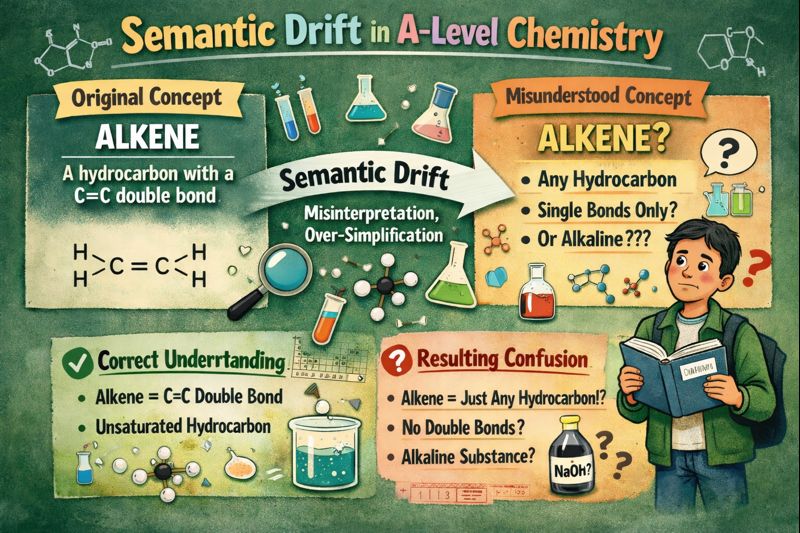
Chemistry is not just a science of atoms and equations; it is also a language-rich discipline in which the meaning of terms matters just as much as the calculations. However, the words that students carry from everyday use often conflict with their scientific definitions, creating what educational researchers call semantic drift. Semantic drift occurs when familiar vocabulary takes on new scientific meanings, and students unintentionally transfer ordinary meanings into chemistry contexts, undermining understanding and performance on assessments and in the laboratory (RSC Education, Avoid the pitfalls of language).(edu.rsc.org)
This article explores how semantic drift operates across key chemistry concepts, how it contributes to enduring misconceptions, and how intentional instructional design can help students navigate the specialised language of chemistry.
What Is Semantic Drift — And Why It Matters in Chemistry.
Semantic drift arises when words have multiple context-dependent meanings. In chemistry, many terms — reaction, dissolve, equilibrium, concentration, and energy exist in common language with different connotations than in scientific usage. When students bring familiar meanings into chemistry contexts without reconciling them with technical definitions, they risk building conceptual misunderstandings that interfere with deeper learning (RSC Education, Avoid the pitfalls of language).(edu.rsc.org)
Research in science education confirms that chemistry language poses inherent challenges for learners. In some studies, even tertiary-level students struggled to interpret technical vocabulary and symbolic representations accurately, revealing that fluency with scientific terms is not automatically acquired through exposure alone (Vladušić, Bucat & Ožić studied in Crawley et al.)(RSC Publishing). Another line of research highlights that chemistry vocabulary often functions as dual-meaning terms, where everyday meanings conflict with narrow, context-dependent scientific definitions, leading directly to learner confusion (General chemistry research on dual-meaning vocabulary). (RSC Publishing)
Because chemistry depends on highly organised conceptual systems built from foundational vocabulary, semantic drift can erode the entire knowledge structure rather than causing isolated errors in the LLM.
Chemistry Language: A Perfect Storm for Drift.
Several features of chemistry make it especially susceptible to semantic drift.
1. Vocabulary Overlap with Everyday Language.
Terms such as dissolve and reaction have everyday uses that differ dramatically from their scientific definitions. For example, a student might say “the salt disappeared,” because in common speech, dissolve often means vanish. Yet in chemistry, dissolution involves solute particles becoming uniformly dispersed and surrounded by solvent molecules — they don’t “disappear,” but remain present in solution (RSC Education, Avoid the pitfalls of language).(edu.rsc.org)
2. Polysemous Terms (Multiple Scientific Meanings)
Some words have distinct technical meanings within chemistry itself, such as concentration, which refers to both quantity per unit volume and relative proportion in mixtures, depending on the context. When multiple scientific senses exist within a discipline, students may blend them, compounding semantic drift.
3. Abstract, Multi-Level Language.
Chemistry language operates simultaneously at the macroscopic, submicroscopic, and symbolic levels. When students lack fluency in linking these levels, even correct vocabulary can produce surface-level understanding detached from deep conceptual interpretation — a known problem in chemical language research (Edelsztein et al.).(De Gruyter Brill)
4. Language Barriers in Multilingual Settings.
In classrooms where learners use English as a second language, semantic drift is magnified by the simultaneous challenges of second-language acquisition and scientific meaning making. Studies show that leveraging students’ home language can support conceptual understanding by anchoring unfamiliar scientific meanings to familiar linguistic frameworks.(scholarworks.aub.edu.lb)
Semantic Drift in Action: Key Concept Examples.
Semantic drift manifests in specific concepts that frequently surface in student error patterns.
1. Reaction
In everyday speech, “reaction” might refer to a personal response (“her reaction was laughter”). However, in chemistry, it denotes a chemical transformation involving bond breaking/forming with associated energy and species changes. Students’ incorrect uses of the term often reflect the everyday sense rather than the process-focused scientific sense, disrupting mechanistic reasoning and assessments of reaction dynamics.(edu.rsc.org)
2. Equilibrium.
Typically, “equilibrium” suggests balance with equal parts. In chemical equilibrium, textbooks define it as a dynamic state where forward and reverse reaction rates are equal, even though observable concentrations appear static. Students’ interpretations that “equilibrium means equal amounts of substances” reveal semantic transfer from common language to scientific context and underpin persistent misunderstandings of Le Chatelier’s principle and related tasks.(edu.rsc.org)
3. Dissolve.
When students use dissolve to imply disappearance (e.g., “the sugar vanished”), they conflate everyday imagery with the scientific process of solute–solvent interaction, misrepresenting solution chemistry and concentration reasoning. (edu.rsc.org)
4. Strong
In ordinary use, strong implies power or intensity. In acid–base chemistry, a strong acid dissociates extensively in water, not necessarily one that is highly concentrated or dangerous. This semantic shift leads some learners to oversimplify concepts or make incorrect predictions in neutralisation contexts.(RSC Publishing)
These examples illustrate how everyday meanings can overshadow scientific ones and how repeated use without semantic clarification reinforces misconceptions rather than correcting them.
Impact on Student Performance and Misconceptions
Semantic drift influences performance across cognitive tasks
A. Structured Assessments.
Research in chemistry education demonstrates that students may select correct answers in multiple-choice items yet fail to justify them with scientifically anchored explanations, indicating surface proficiency rather than meaningful understanding. (Semantic Scholar) In tasks requiring explanation, semantic assumptions often leak into reasoning, revealing the persistence of everyday associations.
B. Transfer to New Contexts.
When learners encounter similar vocabulary in new scenarios (e.g., applying equilibrium reasoning to kinetics), misaligned semantic structures cause errors that are not easily resolved through procedural practice alone. (RSC Publishing).
C. Longitudinal Language Challenges.
Open-access studies show that even when students initially adopt scientific meanings under instruction, semantic drift can reassert itself when students engage with complex problems or unfamiliar contexts, indicating that vocabulary learning is not static but dynamic and fragile.(Springer)
This body of evidence positions semantic drift not as an incidental issue but as a foundational barrier to mastering chemistry concepts.
How Traditional Teaching Perpetuates Semantic Drift.
Many teaching sequences inadvertently reinforce semantic drift through the following:
- Definition memorisation without context
- Lack of explicit contrast between everyday and scientific meanings
- Assessment focused on procedural correctness rather than linguistic interpretation
- Textbooks that themselves conflate levels of meaning (macroscopic, symbolic, and microscopic), everyday. (RSC Publishing)
Textbook researchers note that semantic errors and didactic difficulties, such as conflating the amount of substance with mass, volume, or molar quantity, arise from inappropriate semantic associations in instructional materials, contributing to more profound conceptual misunderstandings. (American Chemical Society Publications)
Instructional Strategies to Counter Semantic Drift.
Educational research suggests several evidence-based approaches.
1. Explicit Meaning Contrast.
Teachers should explicitly contrast everyday and scientific meanings of key terms, creating tasks in which students justify which meaning applies in a given context and why.
2. Semantic Mapping Activities.
Semantic maps that tie vocabulary to multiple contexts help students visualise meaning ranges and guard against conflation.
3. Context-Rich Tasks.
Using authentic scientific texts and problems that require students to interpret terms with precision fosters fluency in disciplinary language.
4. Discourse Awareness.
Metalinguistic discussion — talking about how scientific language works — supports students in recognising and adjusting semantic drift tendencies, similar to approaches in multilingual education research.(scholarworks.aub.edu.lb)
5. Scaffolded Transfer.
Teaching should gradually build semantic understanding, requiring students to apply terms across diverse contexts so that scientific meanings are anchored and reinforced rather than overridden by everyday usage.
Conclusion: Language as a Learning Infrastructure.
Semantic drift is not merely an ancillary problem; it is a core cognitive and linguistic barrier in chemistry education. Because scientific understanding depends on the correct interpretation of vocabulary, unexamined semantic drift can persist even after repeated exposure to concepts. Research in chemistry education highlights that meaning matters as much as mechanics (words and representations), and addressing language explicitly should be a central instructional priority.
By attending to vocabulary as a cognitive structure — not merely a set of definitions — educators can help students develop robust and transferable understanding, bridging the gap between everyday reasoning and scientific reasoning.
References.
RSC Education. Avoid the Pitfalls of Language: Help students learn the difference between everyday and chemistry vocabulary. Royal Society of Chemistry education article. https://edu.rsc.org/ideas/avoid-the-pitfalls-of-language/3010601.article (edu.rsc.org)
Crawley, Vladušić, Bucat and Ožić (2016). Language and the teaching and learning of chemistry. Chem. Educ. Res. Pract. DOI:10.1039/C6RP90006B. Evidence that even tertiary students struggle with technical and everyday meaning. (RSC Publishing)
General Chemistry Language Study (2016). General chemistry students’ conceptual understanding and language fluency: acid–base neutralization. Chem. Educ. Res. Pract. DOI:10.1039/C6RP00015K. Addresses dual-meaning vocabulary and student confusion with terminology. (RSC Publishing)
Pekdağ & Le Maréchal (2013). Semantic mistakes and didactic difficulties in teaching the “amount of substance” concept. Chem. Educ. Res. Pract., a semantic analysis of textbook language challenges. (RSC Publishing)
Textbook Semantic Problems Review (2025). A Review of Research on the Quality and Use of Chemistry Textbooks. J. Chem. Educ. Semantic analysis of chemistry textbooks and implications for teaching. (American Chemical Society Publications)
Chemical Language Usage Study (2021). The development of chemical language usage by non-traditional students: An interlanguage analogy. Res. Sci. Educ. Highlights the longitudinal semantic challenges in the adoption of scientific language. (Springer)
Context-Based Language and Chemistry (2021). The Role of Language in Understanding Abstract Chemical Concepts in Multilingual Classrooms. AUB ScholarWorks thesis exploring language practices in chemistry learning. (scholarworks.aub.edu.lb)
 MoyoEd Research
Leave a comment