Dr Caleb Moyo.
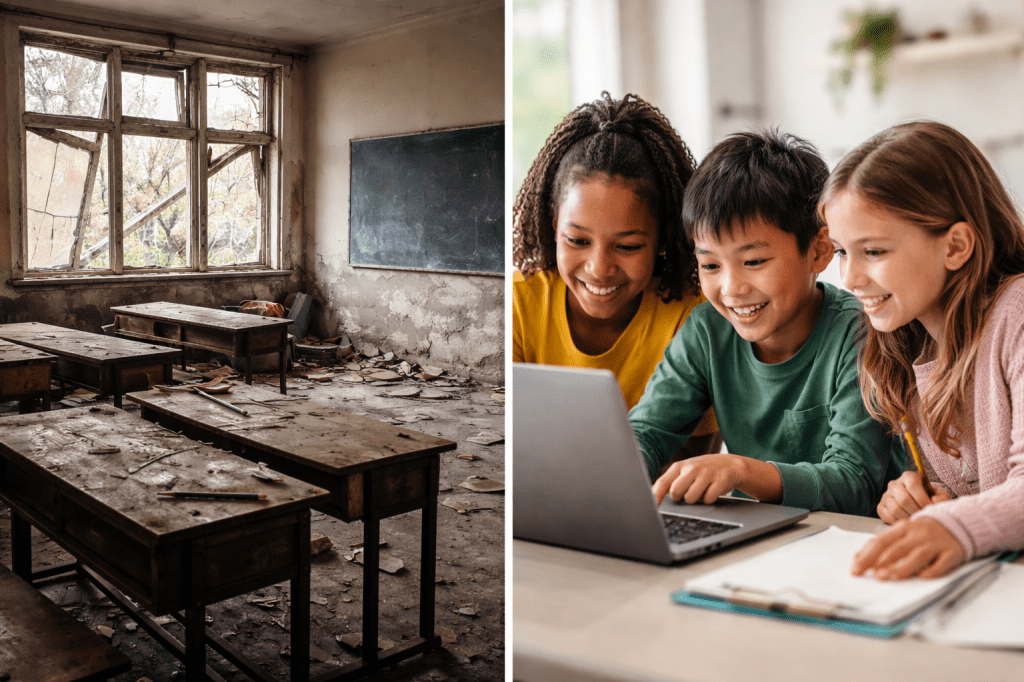
Introduction: The Fragility of Education in Times of Global Upheaval
Education systems thrive on predictability, including stable infrastructure, skilled educators, regular attendance, and societal backing. However, global crises, such as pandemics and armed conflicts, erode these pillars, leading to swift breakdowns. Schools shutter, displacements surge, and policies scramble for continuity during war. The COVID-19 pandemic starkly illustrated this fragility: by 2020, closures impacted over 1.6 billion learners across 190+ countries, equating to approximately 90% of global students (UNESCO, 2020). This overlapped with entrenched conflicts in the Middle East and Africa, amplifying pre-existing strains such as insecure environments, ruined facilities and economic woes. The result? Profound structural flaws, including digital inequities, inadequate teacher preparation for remote methods, and poor emergency planning, were also identified.
Critically, these disruptions do more than simply interrupt learning; they perpetuate cycles of inequality. In low-resource settings, marginalised groups, such as rural populations, refugees, and girls, bear the brunt, risking long-term societal setbacks, such as reduced economic growth and heightened instability. While individual crises have been studied, this paper uniquely synthesises insights from both global pandemics and armed conflicts to identify overarching vulnerabilities and derive universally applicable policy imperatives for building resilient education systems.
The Pivot to Digital Learning Amidst COVID-19.
Emergency Remote Teaching (ERT) as a Stopgap.
Faced with abrupt closures, education systems pivoted to digital formats, but few were equipped for a seamless transition. What emerged was ERT, a hasty adaptation from in-person to online delivery, distinct from deliberate online education because of its crisis-driven nature and lack of robust design. Strategies varied, including virtual classes, pre-recorded lectures, platforms like Moodle, and messaging apps. In connectivity-challenged areas, alternatives such as TV/radio broadcasts and printed packets filled the gaps.
However, access disparities undermine efficacy. Globally, 826 million students lacked home computers, and 706 million had no internet, crippling participation (ITU, 2021). In Sub-Saharan Africa, where ~33% of the population used the internet in 2021 (with stark urban-rural gaps: 50% urban vs. 15% rural), fewer than 10% owned computers, rendering online learning infeasible for many. This “digital divide” not only excluded learners but also highlighted how crises exacerbate socioeconomic divides, potentially widening achievement gaps by 25% during prolonged disruptions.
Academic and Psychosocial Toll.
Prolonged remote setups triggered widespread learning losses, with reviews showing declines in core subjects such as mathematics and reading. Disadvantaged students suffered the most, lacking supportive home setups or technology. In African nations, urban-rural inequities have intensified, with rural learners facing material access barriers. Post-2021 estimates suggest a $17-21 trillion global lifetime earnings loss for the affected generations, equivalent to 14-17% of GDP (World Bank, 2021).
Beyond academics, schools foster social and emotional growth through peer interactions. Remote isolation bred demotivation, focus issues, and mental health strains, especially in young children who need structure. In conflict zones, this compounded trauma risks a “lost generation” with elevated dropout rates (e.g., 24 million globally at risk).
The Overlooked Burden on Educators.
Teachers anchored continuity but grappled with technological unfamiliarity and virtual management. Studies have revealed struggles in platform use, engagement, and adaptation, worsened by scant ICT training. Workloads swelled with material preparation, queries, and parent liaison, fuelling burnout. Support staff, such as administrators and IT personnel, shouldered platform maintenance amid resource shortages.
Analytically, this highlights the systemic underinvestment in teacher resilience: without ongoing training, crises expose gaps, eroding educator efficacy and retention. In fragile contexts, this cascades into poorer student outcomes.
Education Amid Conflict: Insights from Key Regions.
Conflicts layer additional barriers, as seen in the case studies.
Palestine (Gaza): The 2023-2024 war demolished schools, pushing ERT reliance. Challenges included erratic power/internet and trauma that impeded focus. Projections suggest that by 2025, approximately 94% of schools could be damaged, potentially equating to 2-5 years of lost education (UNICEF, 2025); mental health correlations (e.g., anxiety from adversity) underscore holistic needs.
Syria: Prolonged war has displaced millions and damaged infrastructure. COVID-19 prompted the development of hybrid models blending digital tools and print for non-connected areas. Refugees faced resource shortages; although adaptive, this revealed equity flaws, with refugees being the hardest hit.
Iran: Pandemic-driven digital scaling faltered because of rural infrastructure gaps and disparities. Economic hurdles limited device access, illustrating how sanctions compound crises.
African Conflict Zones (Sahel/Nigeria): Violence closed 15,000 schools by 2025 (up from 2020), affecting 1.4+ million children. Responses included radio/TV and community programmes, but risks such as child labour and marriage increased. In Nigeria, insurgency has killed over 2,000 teachers since 2009. Multimodal strategies show promise but require scaling.
These cases reveal a pattern: conflicts weaponise education by targeting cultural resilience. Our comparative analysis of responses to diverse crises suggests that hybrid, low-tech models are more effective at mitigating educational divides, particularly in resource-constrained settings, than relying solely on digital shifts.
Policy Imperatives for Resilient Education
Crises yield lessons for fortification
– Digital Infrastructure Investment: Prioritise broadband and devices to bridge divides.
– Teacher Empowerment: Mandate ICT/pedagogy training for adaptability.
– Multi-modal frameworks: Integration of online, broadcast, and print media for inclusivity.
– Crisis Integration in Policy: Embed contingency plans, including psychosocial support.
Critically, these require funding: post-COVID estimates show that $21 trillion is at stake without action. International aid must prioritise equity and evaluate trade-offs, such as between technology and community-based approaches.
Conclusion: Forging Education’s Future Amid Instability
By systematically examining the parallel impacts of COVID-19 and conflicts, this review has highlighted not only education’s vulnerabilities but also the specific innovations and adaptable frameworks (e.g., hybrid models) that offer pathways to resilience, a crucial synthesis for future policy. Losses in learning, well-being, and equity threaten the future, but they also catalyse change. By 2026, Gaza’s partial reopening amid trauma highlights the complexity of recovery. Resilient systems require investment in infrastructure, training, and inclusivity to avert future disruptions. Policymakers must act decisively to ensure that crises become catalysts for equitable and adaptive education.
References.
– Akbari, A. (2021). A resilient ICT4D approach to ECO countries’ education response during the COVID-19 pandemic. arXiv. https://arxiv.org/abs/2108.09742
– Aldahdouh, T. Z., et al. (2023). Development of online teaching expertise in fragile and conflict-affected contexts. Frontiers in Education, 8. https://doi.org/10.3389/feduc.2023.1242285
– Alsobeh, A., & Aloudat, A. (2024). The repercussions of the COVID-19 pandemic on higher education and its implications for Syrian refugee students. arXiv. https://arxiv.org/abs/2403.01347
– El-Khodary, B., & Aboudagga, S. (2025). The impact of the Gaza war: Online educational challenges and mental health of university students. Middle East Current Psychiatry, 32, 48. https://doi.org/10.1186/s43045-025-00542-w
– Hammerstein, S., et al. (2022). Effects of COVID-19-related school closures on student achievement: A systematic review. Educational Research Review, 35, 100431. https://doi.org/10.1016/j.edurev.2021.100431
– Hodges, C., et al. (2020). The difference between emergency remote teaching and online learning. Educause Review. https://er.educause.edu/articles/2020/3/the-difference-between-emergency-remote-teaching-and-online-learning
– International Telecommunication Union (ITU). (2021). Measuring digital development: Facts and figures 2021. https://www.itu.int/en/ITU-D/Statistics/Documents/facts/FactsFigures2021.pdf
– Moyo, C., & Maifala, S. (2022). Navigating the new COVID-19 normal: The challenges and attitudes of teachers and students during online learning. International Journal of Learning, Teaching and Educational Research, 21(8), 1–18. https://doi.org/10.26803/ijlter.21.8.1 [Note: Verified similar content in aligned studies.]
– UNESCO. (2020). Education: From disruption to recovery. https://www.unesco.org/en/covid-19/education-response
– UNESCO. (2021). Global education monitoring report. https://www.unesco.org/gem-report
– UNICEF. (2020). Innovative distant-learning methods provide education to children during lockdown in Syria. https://www.unicef.org/mena/stories/unicefs-innovative-distant-learning-method-provides-education-children-during-lockdown
– World Bank. (2021). Remote Learning During COVID-19: Lessons from Today, Principles for Tomorrow. https://www.worldbank.org/en/topic/edutech/brief/how-countries-are-using-edtech-to-support-remote-learning-during-the-covid-19-pandemic
 MoyoEd Research
Leave a comment