From Spectacle to Understanding: The Pedagogical Power of Teacher Demonstrations in Chemistry.
Introduction
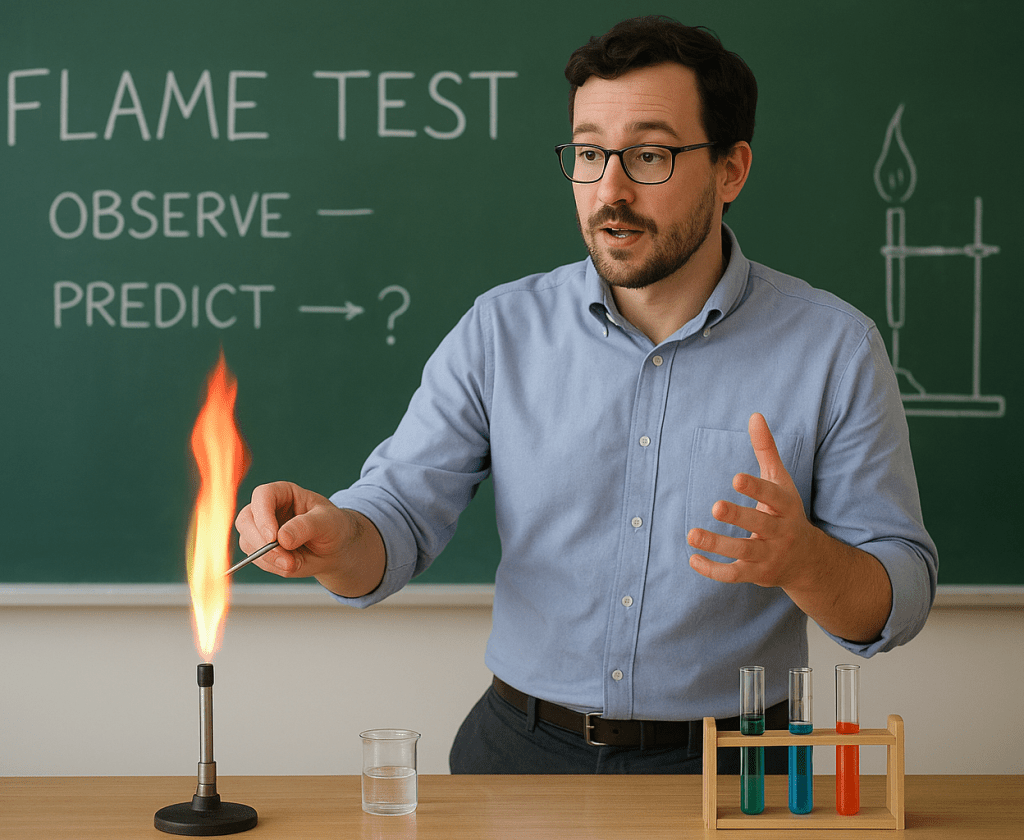
Teacher demonstrations have long been at the heart of chemistry teaching, capturing attention, evoking curiosity, and bringing invisible processes to life. A teacher demonstration is a planned, teacher-led experiment designed to help students observe, interpret, and understand chemical phenomena that are otherwise abstract or unsafe to handle individually.
Historically, demonstrations have served as chemistry’s public face—from 18th-century lecture halls to today’s classrooms—where the teacher acts as both scientist and storyteller. Yet in modern pedagogy, their value lies not merely in entertainment but in promoting conceptual understanding, cognitive engagement, and scientific reasoning.
The current challenge, however, is balance: How can demonstrations engage learners while ensuring lasting understanding rather than fleeting amusement? Recent research (2020–2025) offers compelling insights.
What Recent Research Reveals (2020–2025)
Engagement and Motivation
Teacher demonstrations consistently enhance student motivation and interest in chemistry. A study by Vinko, Delaney, and Devetak (2020) found that demonstrations increased learners’ curiosity and willingness to engage, especially when students were encouraged to predict outcomes or explain phenomena. Engagement alone, however, is not enough—it must be coupled with a deliberate conceptual focus.
Conceptual Understanding and Retention
Research comparing demonstration-based lessons with hands-on labs shows that passive observation rarely yields significant conceptual gains. In contrast, active demonstration strategies, where students predict, observe, and explain, result in deeper understanding and retention (Erdem-Özcan & Uyanık, 2022).
The Predict–Observe–Explain (POE) approach, increasingly validated across studies, encourages students to make predictions, confront evidence, and reconcile results with their mental models or schema (Çırakoğlu, 2022). These cycles create cognitive conflict that drives learning—a process grounded in constructivist learning theory as posited by Vygotsky and others.
Cognitive Load and Design
Demonstrations must be cognitively manageable. Cognitive Load Theory (CLT) suggests that learning is optimal when instructional materials reduce extraneous load (distractions) and support germane processing (schema construction). According to Ayres (2020), effective demonstrations isolate key features, minimise irrelevant theatrics, and integrate visual, symbolic, and verbal cues to support working memory. The teacher as demonstrator controls what is to be focused on during the demonstration.
Digital and Remote Contexts
During the pandemic, video and virtual demonstrations became essential. Studies in the Journal of Chemical Education (Mojica et al., 2021; Diéz-Pascual et al., 2022) showed that digital demonstrations can match or exceed live ones if designed interactively. When students paused videos to predict outcomes or answer embedded questions, conceptual gains improved significantly. The world-wide-web is replete with ideas and apps that can assist here.
Model-Based and Multimodal Learning
Newer frameworks such as model-based reasoning and multimodal learning have enriched how demonstrations are conceptualised. When teachers explicitly link macroscopic reactions (e.g., color change) to microscopic models (e.g., electron transfer) and symbolic representations (equations), students develop stronger causal reasoning (Bolger et al., 2021; Malone et al., 2023). Using animations, diagrams, and verbal explanations together—without overwhelming learners—enhances mental model formation.
Characterising Effective Demonstrations
Teacher demonstrations can be categorised into three pedagogical types:
- Illustrative Demonstrations – used to clarify known ideas (e.g., reactivity of group 1 elements).
- Discrepant Demonstrations – produce surprising results to challenge misconceptions (e.g., exothermic reactions appearing “cold”).
- Model-Building Demonstrations – connect observed events to symbolic or particulate representations.
Research shows that the level of student involvement is a critical determinant of effectiveness:
- Passive viewing sparks attention but fades quickly.
- Predict–observe–explain participation leads to conceptual gains.
- Interactive or co-designed demonstrations, where students suggest variables or interpret data (e.g. reaction kinetics factors), produce the most robust understanding (Carroll, 2024).
When embedded in active learning structures (e.g., think-pair-share or clicker questions), demonstrations also become vehicles for formative assessment—allowing teachers to gauge misconceptions in real time for subsequent clarification.
Practical Strategies for Teachers
Drawing from research and classroom experience, the following workflow turns demonstrations into high-impact learning episodes:
- Clarify the learning objective and success criteria – Define what conceptual or procedural understanding the demonstration should reinforce.
- Activate prior knowledge – Pose a quick question or poll to uncover students’ existing ideas or knowledge (retrieval).
- Prediction – Have learners predict the outcome and justify their reasoning, committing by writing somewhere.
- Demonstrate – Keep it concise; direct toward observable changes and minimise distractions.
- Observation recording – Ask students to note key details (color, gas, temperature changes).
- Explain and reconcile – Discuss outcomes allowing for cross fertilisation of ideas in snowball fashion, linking evidence to theory or models.
- Assess – End with a reflective or formative task to consolidate learning.
This workflow applies both in-person and digitally (via recorded demos or simulations). It aligns with CLT principles, ensuring that demonstrations channel students’ mental effort into meaningful schema-building rather than sensory overload.
Avoiding Common Pitfalls
- Snag: Students enjoy but do not learn.
Fix: Embed prediction, explanation, or post-demo reflection tasks. - Snag: Demonstrations are overly complex.
Fix: Break into stages and focus attention using cues or guiding questions. - Snag: Misconceptions persist.
Fix: Use particulate models or AR visuals to bridge macroscopic and microscopic reasoning (Chen et al., 2020).
The Future of Demonstrations in Chemistry Education
The future lies in hybrid demonstrations; integrating live and virtual elements. Augmented Reality (AR) and simulation-based tools now allow teachers to “zoom in” on molecular structures while performing reactions. A simulation of effects of changes of temperature on fraction of molecules with E ≥ Ea comes to mind. When used thoughtfully, these technologies extend access and enhance inquiry without replacing the cognitive value of direct observation (Chen et al., 2020).
Nonetheless, research urges caution: technology should amplify, not distract from, the core learning goal. As Malone et al. (2023) conclude, it is the model-based dialogue, not the medium, that determines learning outcomes.
Conclusion
Teacher demonstrations remain indispensable in chemistry teaching—not as spectacles but as structured learning experiences. Modern evidence reinforces three key lessons:
- Engagement must lead to explanation. Motivation without conceptual follow-through yields little learning.
- Cognitive design matters. Clarity, segmentation, and focus on essential cues maximise comprehension.
- Active frameworks like POEs and model-based reasoning turn demonstrations into engines of inquiry.
As classrooms evolve with digital and AI-supported tools, demonstrations can continue to bridge curiosity and cognition. The chemistry teacher’s challenge, then, is timeless: to turn wonder into understanding.
References
- Ayres, P. (2020). Something old, something new from cognitive load theory. Computers & Education.
- Bolger, M. S., et al. (2021). Supporting scientific practice through model-based inquiry. CBE—Life Sciences Education.
- Carroll, G. (2024). Towards expansive model-based teaching: A systematic review. Research in Science Education.
- Chen, S.-Y., et al. (2020). Using augmented reality to experiment with elements in a chemistry context. Computers & Education.
- Çırakoğlu, N. (2022). Designing and evaluating an interactive e-book based on the Predict–Observe–Explain method. Education and Information Technologies.
- Diéz-Pascual, A. M., et al. (2022). Remote teaching of chemistry laboratory courses during emergency transitions. Journal of Chemical Education.
- Erdem-Özcan, G., & Uyanık, G. (2022). Effects of the Predict–Observe–Explain strategy on achievement and retention in science learning. Journal of Pedagogical Research, 6(3).
- Malone, K. L., et al. (2023). Modelling-based pedagogy across science disciplines. International Journal of Science Education.
- Mojica, E. R. E., et al. (2021). Challenges encountered and students’ reactions to remote chemistry demonstrations. Journal of Chemical Education.
- Vinko, L., Delaney, S., & Devetak, I. (2020). Teachers’ opinions about the effect of chemistry demonstrations on students’ interest. CEPS Journal.

 MoyoEd Research
Leave a comment