What research shows, what students say, and what examiners quietly despair over.
Dr Caleb Moyo.
Introduction: The Mathematics We Pretend Is Already There.
Senior chemistry qualifications, A-level, International A-level (IAL), and the IB Diploma Programme (DP), are often described as “content-heavy”. However, examiners’ reports tell a different story. Year after year, examiners note that many candidates understand chemistry but lose marks due to weak mathematical reasoning, poor calculation structuring, and misuse of units.
This is not anecdotal. Empirical research consistently demonstrates that mathematical competence is one of the strongest predictors of success in post-16 chemistry, often outweighing conceptual understanding (Scott 2012). The uncomfortable truth is that chemistry does not merely use mathematics; it assumes a level of fluency. And assumptions, as any examiner will tell you, are dangerous things.
1. Stoichiometry and the Mole: Where Understanding Meets Arithmetic Reality.
Where It Appears.
- A-level / IAL: Empirical formulae, limiting reagents, percentage yield, atom economy
- IB DP: Stoichiometry embedded in data-based and unfamiliar contexts, especially HL Paper 2
Nature of the Challenge.
Scott (2012) demonstrated that many students who conceptually understand reactions still fail stoichiometry because they cannot organise multi-step proportional reasoning mathematically (DOI: 10.1039/C2RP00001F). Students struggle to make decisions:
- what the starting quantity should be,
- which mole ratio applies, and
- how to coherently chain the steps.
This failure is structural and not careless.
Research link:
https://doi.org/10.1039/C2RP00001F
Student Voice.
“I know what’s reacting; I just don’t know how to set it out.”
This “starting problem” appears repeatedly in interview-based research.
Examiner Voice.
A-level and IAL examiners frequently note variations in:
“Many candidates selected the correct equation but were unable to use the mole ratio correctly.”
IB examiners similarly report that candidates often “performed a calculation without demonstrating understanding of the chemical relationship involved.”
In IB marking, this costs method and reasoning marks, even when the final value is correct.
Mitigation Measures.
- Teach stoichiometry as proportional reasoning, not as formula application (Mandina & Enunuwe, 2017).
- Require students to write verbal mole ratio statements before calculating.
- Use particulate representations to ground symbolic manipulation (Stieff et al., 2016).
Research link:
https://doi.org/10.1021/acs.jchemed.5b01010
Hard truth: If students rely on memorised “recipes”, IB questions will dismantle them with surgical precision.
2. Units and Proportional Reasoning: The Silent Mark Killer.
Where It Appears
- Concentration (mol dm⁻³)
- Gas equations (Ideal Gas)
- Titrations
- Energetics calculations, including Hess’s law.
Nature of the Challenge.
Johnstone (1991) identified unit misuse as a cognitive overload problem, not as laziness. Students often perform arithmetic correctly but fail to treat units as mathematical constraints (DOI: 10.1039/CT9910000701).
Research link:
https://doi.org/10.1039/CT9910000701
Student Voice.
“I got the number right; I don’t understand why I lost marks.”
Examiner Voice.
Across A-level, IAL, and IB examiner reports, one phrase recurs with grim regularity: “Correct calculation but incorrect or missing units.”
In IB DP, this is particularly unforgiving, as answers without units are simply incomplete.
Mitigation Measures
- Enforce visible unit cancellation in every calculation.
- Penalise missing units in classwork, even when the number is correct (being cruel to be kind).
- Teach students that units are operators and not labels.
Examiners are not pedantic; they are consistent in their grading.
3. Algebra, Logs, and Mathematical Anxiety.
Where It Appears
- A-level / IAL: Arrhenius equation, rate laws, equilibrium constants
- IB DP: pH calculations, logarithmic scales, linearisation of data
Nature of the Challenge.
Mathematical anxiety reduces working memory capacity, impairing problem-solving even when students understand the underlying chemistry (Ursini et al., 2021). This effect is magnified in:
- IB HL Paper 2, where explanation accompanies calculation, and
- A-level synoptic questions that combine multiple mathematical steps.
Research link:
https://doi.org/10.1038/s41539-021-00095-7
Student Voice.
“As soon as logs appear, I panic, even if I know what pH means.”
Examiner Voice.
IB examiners often remark, “Candidates struggled to rearrange equations or interpret logarithmic relationships.”
A-level examiners echo this when students “used equations without demonstrating understanding of the variables involved.”
Mitigation Measures.
- Algebraic manipulation should be taught independently of chemistry first. Students should write the formula and substitute before changing the subject and then use the calculator.
- Use verbal reasoning before symbolic work (“If pH decreases, what happens to [H⁺]?”).
- Normalise struggle; silence implies incompetence.
4. Graphs, Data, and Representation Translation.
Where It Appears.
- Rate graphs
- Enthalpy profile diagrams
- Titration curves
- IB data-based questions:
Nature of the Challenge.
Students often describe graphs correctly but fail to explain them in a chemical context. Taber (2002) identified this as a representation translation failure, moving between graphical, mathematical, and chemical meanings (DOI: 10.1039/9781847559293).
Research link:
https://doi.org/10.1039/9781847559293
Student Voice.
“I can describe the graph; I don’t know what it means chemically.”
Examiner Voice.
Common examiner observations include: “candidates described trends but did not relate them to collision theory/equilibrium principles.”
In IB, this costs explanation marks, even when the trend description is accurate.
Mitigation Measures.
- Explicitly teach graph → equation → concept translation.
- Ask relentlessly: “What does the gradient mean chemically?”
- Avoid teaching kinetics and equilibrium back-to-back without consolidation or teaching equilibrium first.
5. Algorithmic Success vs. Chemical Understanding.
Where It Appears:
- Familiar calculation questions
- Unfamiliar or contextualised exam problems
Nature of the Challenge.
Nurrenbern and Pickering (1987) showed that students who succeed in algorithmic problems often fail to conceptualise variations of the same task, revealing procedural mimicry rather than understanding (DOI: 10.1021/ed064p508).
Research link:
https://doi.org/10.1021/ed064p508
Examiner Voice.
A-level and IB examiners frequently note: “candidates applied memorised procedures without considering whether they were appropriate.”
Mitigation Measures.
- Solve problems using multiple methods.
- Ask students to justify why a method is effective.
- Deliberately use unfamiliar contexts; discomfort builds competence.
Practical Takeaways for A-Level, IAL, and IB Teachers.
| Issue | Examiner Complaint | What Works |
| Stoichiometry | Wrong ratios, no method | Heuristics + mole reasoning |
| Units | Missing / incorrect units | Unit-anchored calculations |
| Logs & algebra | Equation misuse | Pre-chem algebra practice |
| Graphs | Weak explanations | Representation translation |
| Algorithms | Collapse on novel tasks | Multi-path reasoning |
Final Word: Tradition Meets the Evidence.
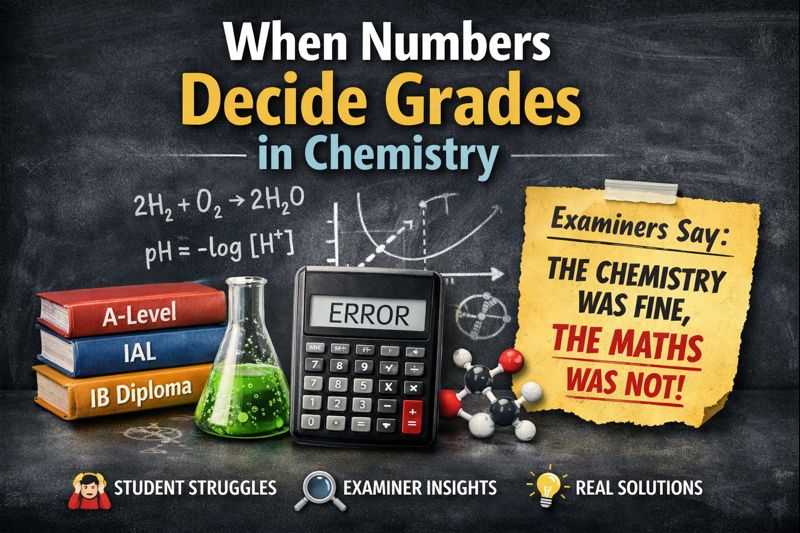
For decades, we have assumed that students should already know mathematics. Researchers and examiners have politely but firmly shown this assumption to be false. A-level, IAL, and IB DP chemistry do not punish weak chemistry; they punish unaddressed mathematical fragility in chemistry. Chemistry is demanding. Mathematics is unforgiving in this regard, and together they require explicit teaching rather than hopeful inheritance. Or, as one might summarise an examiner’s report in plain English: “The chemistry was fine. The maths was not.”
References
- Scott, F. J. (2012). Is mathematics to blame for chemistry students’ performance?
https://doi.org/10.1039/C2RP00001F - Johnstone, A. H. (1991). Why is science difficult to learn?
https://doi.org/10.1039/CT9910000701 - Stieff, M. et al. (2016). Representational competence in chemistry
https://doi.org/10.1021/acs.jchemed.5b01010 - Ursini, S. et al. (2021). Mathematics anxiety and STEM performance
https://doi.org/10.1038/s41539-021-00095-7 - Taber, K. S. (2002). Chemical misconceptions
https://doi.org/10.1039/9781847559293 - Nurrenbern, S. C., & Pickering, M. (1987). Concept learning versus problem solving
https://doi.org/10.1021/ed064p508
 MoyoEd Research
Leave a comment