Dr. Caleb Moyo.
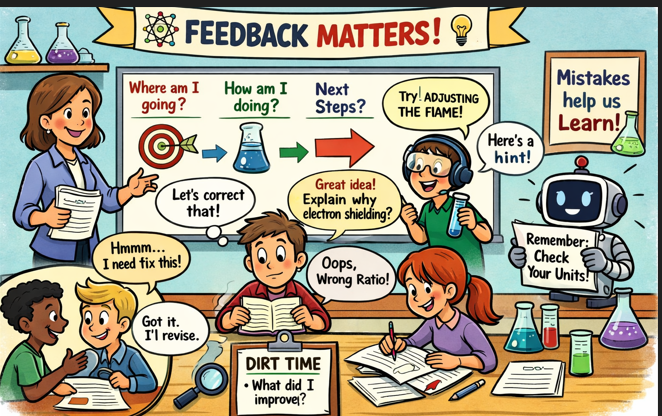
In science education, feedback functions as diagnostic evidence. It reveals misconceptions, gaps in reasoning, and procedural weaknesses before they solidify. When you design feedback with precision and purpose, you accelerate conceptual understanding and strengthen scientific thinking.
Large-scale evidence confirms that high-quality feedback exerts a substantial influence on student achievement when it is specific, timely, and improvement-focused. In their synthesis of research, John Hattie and Helen Timperley demonstrate that feedback has one of the strongest impacts on learning when it targets the task, the process, and self-regulation rather than personal traits. Paul Black and Dylan William similarly show that formative assessment practices significantly improve attainment when embedded in daily classroom routines.
Feedback is not a single method. It includes whole-class feedback, written comments, verbal conferencing, peer dialogue, directed improvement and reflection time, practical work feedback, and AI-assisted approaches. The key question is not whether you give feedback. The question is whether your feedback changes thinking.
What Makes Feedback Effective?
Hattie and Timperley define feedback as information that answers three questions.
• Where am I going.
• How am I going.
• What are my next steps.
Effective feedback aligns with explicit learning intentions and success criteria. It identifies the gap between current and desired performance. It provides actionable next steps. Research shows that vague praise, such as “good work,” has a negligible impact. Students value clarity, specificity, and guidance that they can implement.
In high school chemistry, this means you move beyond “check your calculation” and instead state, “Recalculate using the correct mole ratio from the balanced equation.” Precision drives improvement.
Whole Class Feedback. High Impact, Manageable Workload.
Whole-class feedback addresses patterns rather than isolated errors. Instead of writing extensive comments in every book, you analyse common strengths and misconceptions and respond collectively.
Why this works:
• You target shared misconceptions such as incorrect mole ratios or confusion between rate and equilibrium.
• You protect teacher workload.
• You normalise error as part of scientific learning.
Research on classroom dialogue in science shows that structured discussion improves conceptual understanding when feedback is immediate and explicit. After marking a stoichiometry assessment, you might:
• Identify frequent errors in unit conversion.
• Model a high-quality response under a visualiser.
• Ask students to annotate and correct their own scripts.
This approach strengthens metacognition. Students see patterns in their thinking. They correct errors actively rather than passively reading marginal notes.
Directed Improvement and Reflection Time (DIRT).
Feedback without response time fails. Students read comments, note the grade, and move on. Directed Improvement and Reflection Time operationalises the evidence that feedback only influences learning when students act on it.
A structured DIRT routine in science may include:
• A fixed 15-minute improvement window.
• Redrafting explanations of collision theory.
• Correcting graph interpretations in rate experiments.
• Writing a short reflection on what changed and why.
Self-regulation represents one of the most powerful levels of feedback. When students identify their own misconceptions and articulate corrections, they develop a durable understanding rather than surface compliance.
Feedback during practical work.
Laboratory sessions provide continuous opportunities for formative feedback. Yet in many classrooms, practical work becomes procedural monitoring rather than conceptual coaching.
Effective practical feedback operates at three levels.
Procedural feedback:
• Correcting titration technique.
• Adjusting flame control with a Bunsen burner.
• Reinforcing safe handling of acids and alkalis.
Conceptual feedback:
• Probing why the endpoint changed colour.
• Challenging confusion between completion and dynamic equilibrium.
• Questioning assumptions about limiting reagents.
Reflective feedback:
• Structured post-lab debrief.
• Evaluation sheets focused on error analysis.
Research in the Journal of Chemical Education shows that structured formative techniques in chemistry increase conceptual understanding and student confidence. Immediate correction during experimentation prevents misconceptions from becoming entrenched.
Written Feedback. Precision over Volume.
Written comments remain effective when you apply restraint. Cognitive load theory suggests that excessive annotation overwhelms working memory. Students act on fewer, clearer targets.
Effective written feedback:
• Links directly to success criteria.
• Focuses on two or three high-leverage improvements.
• Uses subject-specific language.
For example: “You identified the periodic trend correctly. Next step: explain it using electron shielding and effective nuclear charge.” This directs conceptual development rather than surface editing.
Peer Feedback and Scientific Dialogue.
Structured peer feedback enhances accountability and communication. When scaffolded with rubrics and modelling, it deepens conceptual understanding.
To maintain quality:
• Provide explicit success criteria.
• Model constructive phrasing.
• Use structured prompts such as one strength and one improvement.
Dialogic interaction in science classrooms correlates with improved reasoning. Students articulate explanations, critique evidence, and refine arguments. These are core disciplinary practices.
AI-assisted feedback. Opportunity with Caution.
Artificial intelligence systems now generate comments on lab reports, provide automated quiz responses, and identify writing issues. Emerging research comparing large language models with teacher feedback indicates that AI can offer structured guidance but lacks contextual sensitivity and deep diagnostic insight.
Potential advantages:
• Immediate formative feedback.
• Support for drafting and redrafting.
• Identification of common language errors.
• Data aggregation across classes.
Risks:
• Over-reliance that weakens independent reasoning (critical thinking).
• Inaccurate scientific explanations.
• Unequal access across students (equity).
• Passive acceptance of suggestions without evaluation.
In chemistry, factual precision matters. An incorrect explanation of redox or equilibrium can propagate errors rapidly. You must treat AI as a support tool, not an authority.
Safeguarding Guardrails for AI Integration.
To integrate AI responsibly in science classrooms, implement clear guardrails.
- Drafting support, not final judgement. Students verify AI feedback against textbooks and their teacher’s instructions.
- Transparency. Discuss limitations and strengths openly.
- Critical evaluation tasks. Ask students to critique AI-generated explanations and identify inaccuracies.
- Data protection compliance. Ensure platforms align with school safeguarding policies.
- Human oversight. Teachers retain responsibility for diagnosing misconceptions in core chemistry concepts.
AI augments professional judgment. It does not replace it.
Building a Feedback Culture.
Feedback effectiveness depends on relational trust. Students act on feedback when they perceive it as supportive and credible. Avoid identity-based comments. Focus on strategies and evidence.
Shift classroom language from grades to growth. Replace “What did I get?” with “What will I improve?” Create routines where improvement becomes visible and expected.
Common Pitfalls to Avoid.
• Marking everything in detail.
• Providing grades without guidance.
• Offering correction without development.
• Giving feedback without a structured response time.
• Ignoring student perceptions.
Feedback functions as a system. You design objectives, gather evidence, provide guidance, and create time for action.
A Departmental Framework for Science.
To ensure coherence across a science department, align practice around these principles:
- Clear learning intentions and success criteria.
- Regular whole-class feedback to address patterns.
- Weekly DIRT sessions.
- Structured peer review in extended writing.
- Planned feedback checkpoints in practical work.
- Selective high-impact written comments.
- Responsible AI integration with guardrails.
- Periodic student perception surveys to refine practice.
When feedback aligns with curriculum goals, practical application, and student reflection, you move from reactive marking to strategic improvement.
In chemistry, reactions require a certain amount of activation energy. In learning, improvement requires structured feedback and deliberate response. When you design feedback with clarity, timing, and professional judgment, you develop not only higher examination performance but also stronger scientific thinkers.
References.
[1] J. Hattie and H. Timperley, “The power of feedback,” Review of Educational Research, vol. 77, no. 1, pp. 81–112, 2007. https://doi.org/10.3102/003465430298487
[2] P. Black and D. Wiliam, “Assessment and classroom learning,” Assessment in Education, vol. 5, no. 1, pp. 7–74, 1998. https://doi.org/10.1080/0969595980050102
[3] C. Brandmo and S. M. Gamlem, “Students’ perceptions and outcome of teacher feedback: A systematic review,” Frontiers in Education, 2025. https://doi.org/10.3389/feduc.2025.1572950
[4] L. Howe et al., “Teacher–student dialogue and conceptual learning in science,” Research in Science Education, 2019. https://doi.org/10.1007/s11165-019-9843-y
[5] M. Babinčáková, “Introduction of formative assessment classroom techniques (FACTs) to school chemistry teaching,” Journal of Chemical Education, vol. 100, pp. 3276–3290, 2023. https://doi.org/10.1021/acs.jchemed.3c00591
[6] K. Seßler et al., “Towards adaptive feedback with AI: Comparing the feedback quality of LLMs and teachers,” arXiv, 2025. https://doi.org/10.48550/arXiv.2502.12842
 MoyoEd Research
Leave a comment