Dr. Caleb Moyo
Abstract.
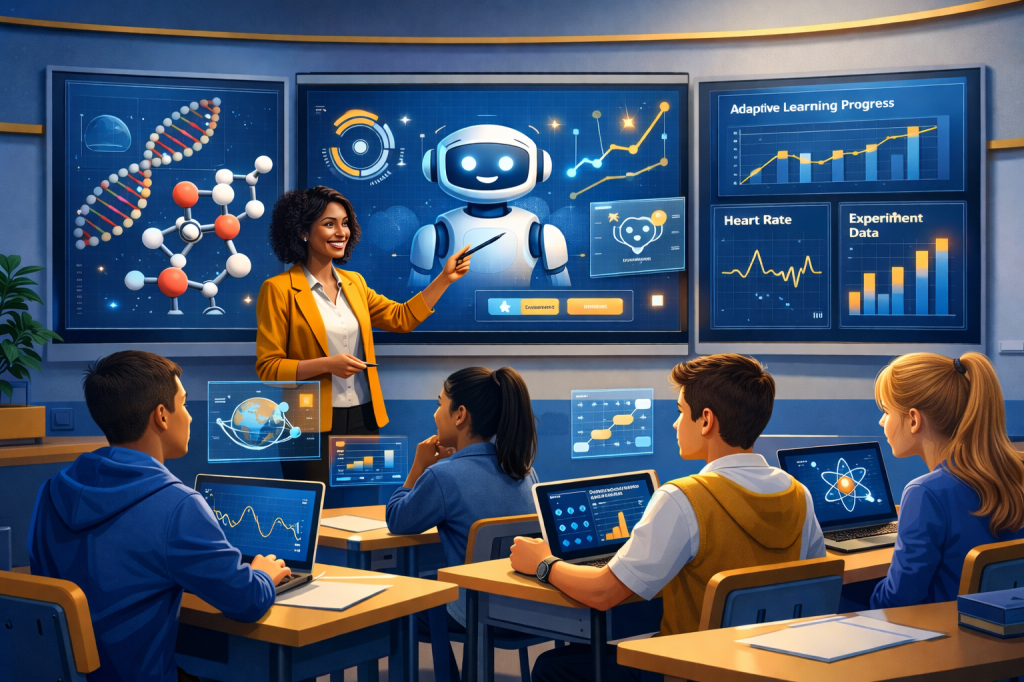
AI-driven teaching integrates artificial intelligence into instructional design, delivery, and assessment to enhance learning outcomes. Intelligent learning ecosystems extend this integration by connecting learners, educators, and data systems within adaptive environments. This paper synthesises research from 2018 to 2026 to examine the impact of AI on engagement, personalisation, and academic performance, with a focus on science education. Evidence indicates that adaptive learning systems, intelligent tutoring systems, and learning analytics significantly improve student outcomes when aligned with pedagogical goals. Practical applications, limitations, and ethical considerations are critically examined to inform effective implementation.
Keywords: AI in education, intelligent learning ecosystems, adaptive learning, AI in science teaching, personalised learning, learning analytics.
1. Introduction
Artificial intelligence (AI) is reshaping educational practice by enabling adaptive, data-informed instruction. AI-driven teaching embeds intelligent systems within learning processes, while intelligent learning ecosystems integrate platforms, analytics, and users into responsive environments.
Empirical evidence demonstrates that AI enhances engagement and academic performance when used to personalise learning and provide timely feedback. Large-scale reviews confirm that adaptive systems improve outcomes when instruction aligns with learner readiness [1]. Intelligent tutoring systems (ITS) produce gains comparable to one-to-one tutoring in structured domains such as science and mathematics [2]. Learning analytics further supports early intervention and precision teaching through real-time data insights [3].
2. Foundations of AI-driven Learning.
2.1 Adaptive Learning and Personalisation
Adaptive learning systems dynamically adjust content, pacing, and difficulty based on learner data. Research shows that alignment between learner readiness and task complexity improves retention [4]. Immediate feedback reduces misconceptions and strengthens conceptual understanding [5]. Personalised pathways increase motivation and persistence, particularly in digitally mediated environments [6].
AI enables continuous personalisation beyond static differentiation, supporting diverse learning trajectories at scale.
2.2 Intelligent Tutoring Systems.
Intelligent tutoring systems provide structured guidance, real-time feedback, and interactive dialogue. Evidence indicates significant improvements in problem-solving and conceptual understanding in STEM education [2], [5]. These systems replicate key aspects of expert instruction through adaptive responses to learner input.
2.3 Learning Analytics.
Learning analytics applies data to inform instructional decisions. Key applications include identifying at-risk learners, monitoring progress, and enabling targeted interventions. When educators act on analytics insights, student outcomes improve significantly [3].
3. Impact on Teaching and Learning.
3.1 Student Engagement.
AI enhances engagement through interactive content, adaptive pathways, and immediate feedback. Gamified environments further increase participation and task persistence.
3.2 Academic Performance.
AI supports continuous assessment and targeted remediation. Mastery-based progression ensures that students achieve conceptual understanding before advancing, improving overall performance.
3.3 Personalisation at Scale.
AI enables scalable differentiation by providing individualised learning pathways and real-time instructional adjustments. This allows educators to address diverse learner needs efficiently.
4. AI Tools in Educational Practice.
AI tools support multiple dimensions of teaching and learning:
- Generative AI systems support lesson planning, explanation, and assessment design [9]
- Adaptive platforms reinforce learning through retrieval practice and spaced repetition
- Learning management systems integrate communication, assessment, and analytics
- Multimodal AI environments support simulations, modelling, and data analysis
These tools enhance both general pedagogy and domain-specific instruction, particularly in science education.
5. Applications in Science Education
5.1 Simulations and Modelling
AI enables visualisation of complex systems, including molecular structures and physical processes. Simulations support conceptual understanding and hypothesis testing.
5.2 Real-time Data Analysis
Students can analyse experimental data instantly, identify trends, and engage in authentic scientific practices. This strengthens analytical and interpretive skills.
5.3 Inquiry-based Learning
AI supports research design, hypothesis generation, and iterative experimentation. Real-time feedback enhances scientific reasoning and methodological rigour.
5.4 Experimental Access
Virtual laboratories provide safe, repeatable experimentation and access to scenarios that would otherwise be inaccessible. This expands opportunities for practical learning.
6. Limitations and Risks
Despite its benefits, AI introduces several challenges. Algorithmic bias may reinforce existing inequities if training data are not diverse [6]. Data privacy concerns require robust governance frameworks. Over-reliance on AI tools may weaken independent thinking and reduce critical engagement. Reduced human interaction may also impact collaborative and social learning processes. AI should support, not replace, professional judgement.
7. Ethical Considerations.
7.1 Data Privacy.
Educational institutions must ensure secure data management, transparent policies, and compliance with regulatory frameworks.
7.2 Academic Integrity
Assessment design should prioritise reasoning and application. Educators must explicitly teach responsible AI use.
7.3 Bias and Fairness.
AI outputs require critical evaluation. Diverse datasets and inclusive design reduce bias and improve equity.
8. The Evolving Role of the Teacher.
The role of the teacher shifts toward facilitation, instructional design, and ethical oversight. Educators interpret data, guide learning processes, and ensure responsible AI integration.
9. Future Directions.
AI will continue to shape education through:
- Human–AI collaboration, improving decision-making and efficiency
- Integrated learning ecosystems, combining platforms and analytics
- Multimodal learning, integrating text, visual, and audio inputs
- Lifelong learning systems, supporting continuous professional development.
10. Conclusion.
AI-driven teaching and intelligent learning ecosystems enhance engagement, personalisation, and academic performance. Effective implementation depends on pedagogical alignment, ethical considerations, and informed use of data. AI offers substantial benefits when integrated thoughtfully within educational practice.
References.
[1] W. Holmes, M. Bialik, and C. Fadel, Artificial Intelligence in Education. Boston, MA, USA: Center for Curriculum Redesign, 2019. [Online]. Available: https://curriculumredesign.org/our-work/artificial-intelligence-in-education/
[2] W. Ma, O. Adesope, J. Nesbit, and Q. Liu, “Intelligent tutoring systems and learning outcomes: A meta-analysis,” Journal of Educational Psychology, vol. 112, no. 4, pp. 764–783, 2020. doi: 10.1037/edu0000429
[3] D. Ifenthaler and J. Yau, “Utilising learning analytics for study success,” Educational Technology Research and Development, vol. 68, pp. 277–299, 2020. doi: 10.1007/s11423-020-09829-y
[4] J. F. Pane, E. D. Steiner, M. D. Baird, and L. S. Hamilton, Informing Progress in Personalized Learning. Santa Monica, CA, USA: RAND Corporation, 2017. doi: 10.7249/RR2042
[5] K. VanLehn, “Advances in intelligent tutoring systems,” International Journal of Artificial Intelligence in Education, vol. 29, pp. 1–22, 2019. doi: 10.1007/s40593-018-0172-3
[6] O. Zawacki-Richter, V. I. Marín, M. Bond, and F. Gouverneur, “Systematic review of research on artificial intelligence applications in higher education,” International Journal of Educational Technology in Higher Education, vol. 16, no. 39, 2019. doi: 10.1186/s41239-019-0171-0
[7] H. L. Roediger and A. C. Butler, “The critical role of retrieval practice in long-term retention,” Trends in Cognitive Sciences, vol. 15, no. 1, pp. 20–27, 2011. doi: 10.1016/j.tics.2010.12.003
[8] R. Luckin, W. Holmes, M. Griffiths, and L. B. Forcier, “Intelligence unleashed: An argument for AI in education,” Nature Human Behaviour, vol. 6, pp. 1–3, 2022. doi: 10.1038/s41562-021-01218-4
[9] E. Kasneci et al., “ChatGPT for education: Opportunities and challenges,” Nature Machine Intelligence, vol. 5, pp. 105–107, 2023. doi: 10.1038/s42256-023-00665-3
[10] D. Ifenthaler and C. Schumacher, “Student perceptions of privacy principles for learning analytics,” Computers in Human Behavior, vol. 107, 2021. doi: 10.1016/j.chb.2021.106699
 MoyoEd Research
Leave a comment