Dr. Caleb Moyo.
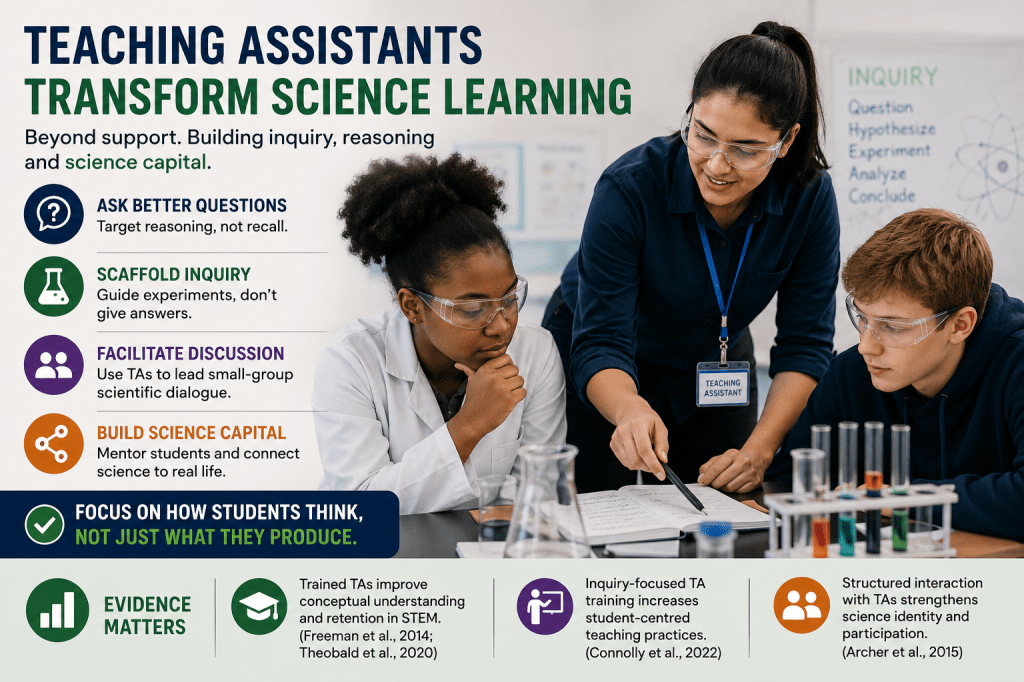
Teaching assistants shape students’ daily science learning experiences. Their influence is most visible in laboratories, small group discussions, and moments of difficulty, where students need targeted guidance. Evidence from 2015 to 2025 shows that their impact depends on role design, training, and alignment with inquiry-based pedagogy. When used strategically, teaching assistants strengthen the science capital and deepen engagement in authentic scientific practice. When used narrowly, their contributions remain limited.
Science education research has identified active engagement in disciplinary practices as a key driver of learning. These practices include modelling, experimentation, data analysis, and argumentation. Students show higher conceptual understanding when they participate in these processes rather than following procedural instructions (Freeman et al., 2014; Theobald et al., 2020). Teaching assistants often control access to these practices in the classroom. In laboratory environments, they guide experimental work, interpret errors, and respond to student questions. Their instructional decisions shape the cognitive demands of tasks. Recent research has shown that moment-to-moment interactions between teaching assistants and students influence how knowledge is constructed and how evidence is interpreted (Reinholz et al., 2024).
Science capital provides a robust framework for understanding this influence on students’ aspirations. Science capital refers to the accumulation of science-related knowledge, attitudes, experiences, and social networks that shape participation in science (Archer et al. 2015). Students with higher science capital demonstrate stronger aspirations, persistence, and confidence in science. Teaching assistants contribute directly to this process through their repeated interactions. They influence students’ perceptions of science and their roles within it.
This influence operates in multiple domains. Regular dialogue with teaching assistants strengthens students’ use of scientific language and reasoning skills. Encouragement and targeted feedback shape confidence and willingness to engage in the learning process. Teaching assistants provide access to information on academic pathways and research opportunities. They also act as near-peer role models, making science appear more accessible. Empirical evidence shows that structured engagement with trained assistants improves retention and participation in science courses, especially among underrepresented groups (Eddy et al., 2015).
The effectiveness of teaching assistants depends on their structured professional development. Research shows that assistants who receive curriculum-linked training adopt more student-centered and inquiry-based practices (Connolly et al., 2022). These assistants use higher-order questioning, promote reasoning, and avoid providing direct responses. Training must be aligned with the teaching tasks. It should include modelling effective practice, opportunities for rehearsal, and structured reflection. Generic or short-term training has a limited impact.
A central shift in practice involves moving from supervision to inquiry-based facilitation. In many science classrooms, practical work is reduced to mere procedural compliance. Students follow instructions without engaging in the reasoning process. Teaching assistants can change this pattern by focusing on cognitive scaffolding, e.g., when assisting students with their science fair projects or research competitions. Structured questioning is therefore critical. Questions should target reasoning rather than recall skills. For example, students can be asked to justify their conclusions, evaluate evidence, or propose alternative explanations. Research has shown that this approach increases cognitive demand and improves conceptual understanding (Linton et al., 2019).
Guided inquiry also requires assistants to support the experimental design. Rather than providing step-by-step instructions, they guide students to select variables, predict outcomes, and evaluate reliability. Inquiry-based laboratory studies have shown that this approach improves analytical skills and scientific literacy (Gormally et al., 2016). Feedback should focus on the thinking processes. Teaching assistants should comment on how students interpret the data, handle uncertainty, and construct explanations. This strengthens metacognition and supports the transfer of learning.
Peer discussions provide another mechanism for impact. Teaching assistants can facilitate structured small-group dialogues where students explain ideas and critique evidence. Evidence shows that peer discussions improve conceptual understanding in science education (Smith et al., 2011). Teaching assistants play a key role in managing these interactions and maintaining a focus on reasoning.
Laboratory environments provide a high-impact context for teaching assistants’ engagement. Research has shown that the presence of trained assistants improves both performance and persistence in science courses (Theobald et al., 2020). Effective practice requires a shift from rigid protocols to problem-based tasking. Teaching assistants should prompt design decisions, encourage multiple solution pathways, and guide post-laboratory reflections. This approach positions students as active participants in the construction of knowledge. In this way, timeous feedback is given to needy students.
Teaching assistants also play a central role in building science capital through interactions. Mentoring conversations are thus critical. Assistants can discuss academic pathways, research opportunities, and scientific careers. These interactions increase students’ aspirations and engagement (Archer et al., 2015). Representation is also important. Near-peer role models from diverse backgrounds improve belonging and persistence, particularly among underrepresented students (Dennehy & Dasgupta, 2017). Teaching assistants can also connect scientific concepts to real-world applications, increasing their relevance and motivation. Context-based learning research supports this approach as a means of improving student engagement.
Encouraging participation is another key function of the program. Teaching assistants can identify disengaged students and provide them with targeted support. Strategies include inviting contributions, validating responses, and reducing the fear of error. These practices increase confidence and participation among students. They also contribute to the development of scientific capital.
Despite the strong evidence, teaching assistants are often underutilised. Common issues include assigning administrative tasks, using assistants as substitutes for qualified teachers, and not providing structured training. These practices limit their impact and reduce the quality of instruction (Sharples et al., 2020). Effective deployment requires a clear role definition and alignment with pedagogical goals.
A systematic approach is required to maximise impact. Roles must be clearly defined in terms of inquiry facilitation and science capital development. Teaching assistants should be integrated into lesson design with explicit guidance on when and how to interact with students. Ongoing professional development is essential for this purpose. Observation and feedback systems should be used to monitor practices and support improvements. The impact should be measured through changes in students’ reasoning, participation, and progression in science.
The Learning Assistant model provides a structured example of effective practice. In this model, teaching assistants support active learning through peer instruction and inquiry. They receive regular pedagogical training and work closely with instructors. Research has shown that this approach improves conceptual understanding and student satisfaction in large science courses (Otero et al., 2016). It also reduces the achievement gap.
Teaching assistants should be positioned as integral components of the science pedagogy. Their work must align with inquiry-based learning and science capital development goals. Training must focus on questioning, feedback, and facilitation to achieve this. Their interactions with students should be intentional and evidence-based.
Teaching assistants influence not only what students learn but also how they think and whether they continue in science. When positioned effectively, they extend the reach of high-quality science education. However, when misused, their potential remains unrealised. The responsibility lies in how educational systems are designed and supported.
References.
Archer, L., Dawson, E., DeWitt, J., Seakins, A., & Wong, B. (2015). Science capital: A conceptual, methodological, and empirical argument for extending Bourdieusian notions of capital beyond the arts. Journal of Research in Science Teaching, 52(7), 922–948. https://doi.org/10.1002/tea.21227
Connolly, M. R., Lee, Y. G., & Savoy, J. N. (2022). The effects of doctoral teaching development on early-career STEM scholars’ college teaching self-efficacy. CBE Life Sciences Education, 21(1), ar6. https://doi.org/10.1187/cbe.21-03-0076
Dennehy, T. C., & Dasgupta, N. (2017). Female peer mentors early in college increase women’s positive academic experiences and retention in engineering. Proceedings of the National Academy of Sciences, 114(23), 5964–5969. https://doi.org/10.1073/pnas.1613117114
Eddy, S. L., Brownell, S. E., & Wenderoth, M. P. (2015). Gender gaps in achievement and participation in multiple introductory biology classrooms. CBE Life Sciences Education, 14(3), ar36. https://doi.org/10.1187/cbe.13-10-0204
Freeman, S., Eddy, S. L., McDonough, M., Smith, M. K., Okoroafor, N., Jordt, H., & Wenderoth, M. P. (2014). Active learning increases student performance in science, engineering, and mathematics. Proceedings of the National Academy of Sciences, 111(23), 8410–8415. https://doi.org/10.1073/pnas.1319030111
Gormally, C., Brickman, P., Hallar, B., & Armstrong, N. (2016). Effects of inquiry-based learning on students’ science literacy skills and confidence. CBE Life Sciences Education, 15(2), ar32. https://doi.org/10.1187/cbe.15-04-0092
Linton, D. L., Farmer, J. K., & Peterson, E. (2019). Is peer interaction necessary for optimal active learning? CBE Life Sciences Education, 18(3), ar36. https://doi.org/10.1187/cbe.19-04-0089
Otero, V., Pollock, S., & Finkelstein, N. (2016). A physics department’s role in preparing physics teachers: The Colorado Learning Assistant model. American Journal of Physics, 84(2), 121–127. https://doi.org/10.1119/1.4937321
Reinholz, D. L., Matz, R. L., Cole, R., & Apkarian, N. (2024). Teaching assistant decision-making and instructional practice in undergraduate STEM. Journal of Research in Science Teaching. Advance online publication. https://doi.org/10.1002/tea.21901
Sharples, J., Webster, R., & Blatchford, P. (2020). Making best use of teaching assistants. Education Endowment Foundation. https://educationendowmentfoundation.org.uk/public/files/Publications/Campaigns/TA_Guidance_Report.pdf
Smith, M. K., Wood, W. B., Adams, W. K., Wieman, C., Knight, J. K., Guild, N., & Su, T. T. (2011). Why peer discussion improves student performance on in-class concept questions. Science, 323(5910), 122–124. https://doi.org/10.1126/science.1165919
Theobald, E. J., Hill, M. J., Tran, E., Agrawal, S., Arroyo, E. N., Behling, S., & Freeman, S. (2020). Active learning narrows achievement gaps for underrepresented students in undergraduate STEM. Proceedings of the National Academy of Sciences, 117(12), 6476–6483. https://doi.org/10.1073/pnas.1916903117
 MoyoEd Research
Leave a comment